Most prediction market development timelines you’ll find online are vendor timelines: optimistic, unqualified, and missing the items that actually take the longest. “Launch in 14 days” usually means a demo environment, not a production platform with real user funds, a working oracle, and a smart contract audit on file. “3 to 4 months” usually means the contract code, not the month you spend getting the audit done and the two weeks you lose when the auditor requests changes. This guide separates the four meaningful build paths, gives honest week-by-week timelines for each, and covers what actually causes delays.
Build Path Overview
| Build Path | Timeline | Cost Range | Right For |
|---|---|---|---|
| Integration-first (Polymarket API) | 2–6 weeks | $15K–$40K | Exchanges, wallets, media embedding prediction primitives |
| Clone script / white-label | 4–10 weeks | $10K–$50K + audit | Founders validating a niche before custom build |
| Custom decentralized (from scratch) | 4–5 months | $80K–$180K | Validated niche, 6+ months runway, technical co-founder |
| CFTC-regulated centralized | 12–18 months | $300K–$800K+ | Institutional ambitions, US user base, fiat-first |
Path 1: Integration-First (2–6 Weeks)
The fastest launch path isn’t building anything. It’s using Polymarket’s public CLOB API to build a product layer on top of existing liquidity, existing markets, and existing order books. What you build: your own frontend, onboarding, market browse experience, and WebSocket-powered price display. What you skip: smart contracts, oracle integration, liquidity seeding, and the audit.
Week 1: environment setup, Polymarket API credentials, local development with testnet data. Node.js backend connects to Polymarket’s REST endpoints. MetaMask and WalletConnect wallet auth is wired. Live markets and implied probabilities display.
Weeks 2–3: order placement, portfolio tracking, position management. Users can buy YES and NO tokens through your interface. WebSocket price feeds update in real time. Redis cache handles price state between updates.
Weeks 4–5: UI polish, mobile optimization, soft launch to 200 to 500 beta users. Edge cases fixed from real user feedback. Monitoring set up.
Week 6: public launch.
The constraint of this path is the constraint of Polymarket’s infrastructure. You have no control over market listing, oracle resolution, or fee structures. This path works well if you’re embedding prediction markets into an existing product where speed matters more than control. It’s also the best path for validating whether your target audience engages with prediction mechanics before you commit capital to a custom build.
For the full architectural detail on this approach, see the full guide to building a prediction market platform like Polymarket.
Path 2: Clone Script or White-Label (4–10 Weeks)
A prediction market clone script or white-label platform gives you an independent codebase with your own branding, fee structure, and market categories. This is the most common starting point for early-stage founders in 2026.
Weeks 1–2: vendor contract signed, source code delivered. Developer reviews smart contracts, identifies customization requirements, sets up local environment. Polygon testnet deployment. Redis and PostgreSQL backend running locally.
Weeks 3–4: branding, UI customization, admin panel configuration. Fee tiers set. First five markets created on testnet. Chainlink oracle wired for price-based markets. MetaMask and WalletConnect tested end-to-end.
Weeks 5–6: smart contract audit. This is the step most clone script vendors don’t include in their quoted timeline. Budget two to four weeks for the audit itself, plus one to two weeks for remediation if the auditor finds issues. Budget $12,000 to $25,000. If you skip this, you’re gambling with your users’ deposits.
Weeks 7–8: closed beta with 200 to 500 invited users. Real trades on testnet markets. Settlement tested. Edge cases in the admin panel fixed. Liquidity seeded from operator capital ($5,000 to $15,000 per market for initial AMM depth).
Weeks 9–10: mainnet deployment. Public launch.
The actual range is 4 to 10 weeks depending on audit speed, UI customization needs, and oracle integration complexity. Teams with a dedicated Solidity developer working in parallel with frontend tasks consistently hit the lower end. Teams with a single developer doing everything sequentially hit the higher end.
See the full prediction market script features, cost, and launch guide before committing to a vendor.
Path 3: Custom Decentralized Build from Scratch (4–5 Months)
Building a full prediction market from scratch means writing your own smart contracts, deploying your own oracle integration, building your own matching engine, and passing your own audit. This is the right path if you have a specific market mechanic, a custom liquidity model, or a niche that no existing script supports well.
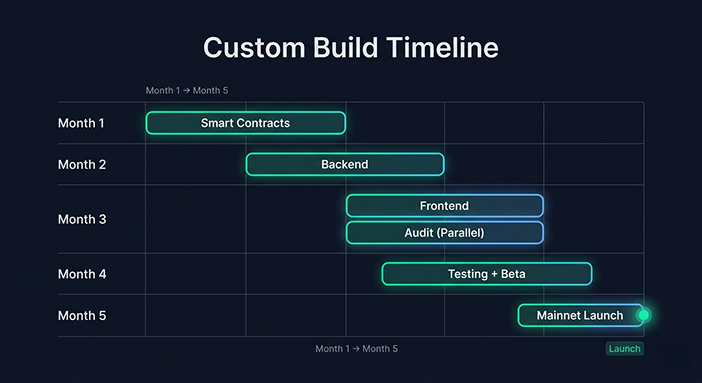
Month 1: Architecture and smart contract development. Solidity developer designs the MarketFactory pattern, implements LMSR AMM, wires the CTF ERC-1155 outcome token structure, and integrates Chainlink Data Streams for price-based markets. UMA Optimistic Oracle integration for event-based markets. Unit tests written with Foundry. Fuzz testing on LMSR math to catch integer overflow before the audit. Four to five weeks with one senior Solidity developer working full-time.
Month 2: Backend development. Node.js API (Fastify), Redis-backed order book, PostgreSQL for off-chain order state, settlement queue batching Polygon transactions, The Graph subgraph indexing MarketCreated and TradePlaced events. WebSocket server for live price streams. Tracks in parallel with the tail end of smart contract development.
Month 3: Frontend development and audit. React with Next.js, Ethers.js wallet integration, MetaMask and WalletConnect, mobile-first UI. The smart contract audit runs in parallel during frontend development. Budget two to four weeks for the audit engagement plus one to two weeks of remediation. Running the audit during frontend work — not sequentially after — saves three to four weeks off the total timeline.
Month 4: Integration testing, testnet hardening, and beta. End-to-end flows tested on Polygon Mumbai testnet. 50 simulated settlement cycles across different market types. Chainlink oracle resolution tested on testnet price feeds. Closed beta with real users. Admin panel workflows validated under realistic load.
Month 5: Mainnet deployment and public launch. Contracts deployed to Polygon mainnet. Liquidity seeded. Monitoring set up with Alchemy alerts and custom dashboards. Public launch with active markets, referral program, and leaderboard running from day one.
Total: 18 to 22 weeks for a well-resourced team with parallel development tracks. Teams running sequentially rather than in parallel typically add six to eight weeks on top of this.
Path 4: CFTC-Regulated Platform (12–18 Months)
If your model requires US users to trade with real money under CFTC oversight — the Kalshi model — the timeline is fundamentally different because regulation is the critical path, not development.
Months 1–3 go to legal structure and regulatory preparation: corporate entity setup, legal counsel engaged, initial CFTC consultation, designation application drafted. This phase costs $50,000 to $150,000 in legal fees alone before a developer writes a line of code.
Months 4–9 run development in parallel with regulatory review. Your centralized order matching engine, KYC onboarding via Sumsub or Onfido, fiat deposit infrastructure (ACH, wire transfer), and full AML monitoring system. The fiat rail integration alone adds six to ten weeks compared to a crypto-native build because you’re dealing with banking relationships and payment processor approval timelines entirely outside your development team’s control.
Months 10–18 cover regulatory approval waiting periods, market self-certification, compliance audits, and soft rollout under regulatory supervision. Kalshi took two-plus years from founding to CFTC designation. Their 2025 $11 billion valuation reflects that compliance moat.
Most startup founders asking how long it takes to build a prediction market app are not building a Kalshi-model regulated exchange. If your target market includes US users trading fiat and you need CFTC coverage, budget 12 to 18 months and $300,000 to $800,000 minimum. If that doesn’t fit your situation, the decentralized path with geo-blocking is the realistic alternative.
What Actually Causes Timeline Delays
The smart contract audit takes longer than planned. The audit takes two to four weeks. What founders don’t budget for is the remediation cycle: if the auditor finds medium or high-severity issues (and they almost always do on a first audit), you fix them and go back for a re-review. That adds one to three weeks. Total realistic audit budget: four to six weeks. Run Slither and MythX automated scanners before engaging the auditor to clear obvious issues and reduce the remediation cycle.
Oracle integration for event-based markets is harder than price feeds. Chainlink Data Feeds for a price-based market takes a few days. Chainlink Any API for a custom event market takes two to three weeks to configure and test reliably. UMA Optimistic Oracle adds another layer: dispute windows, challenge mechanism testing, 12 to 24-hour settlement delay in your UI. If your market roadmap includes custom event markets, add two to three weeks.
Fiat on-ramp integration causes the most surprise delays. Adding MoonPay or Transak takes one to two weeks of development, but their merchant approval process adds two to four weeks on top. ACH or direct bank transfer for US users adds eight to twelve weeks for banking relationship setup. Teams that discover this mid-build lose four to eight weeks because they didn’t scope it at the start.
Scope creep extends timelines by 30% to 50%. A leaderboard adds a week. An achievement system adds another. A mobile app adds a month. Scope your MVP ruthlessly before development starts. Every feature not in the MVP spec gets scheduled for version two. Nothing gets built mid-sprint that wasn’t in the spec.
Liquidity bootstrapping takes longer than the development. Your platform can be technically ready and feel dead to users because the markets have no liquidity. Plan four to six weeks of pre-launch liquidity seeding through a closed beta before public launch. This is not development time, but it’s on your critical path to a launch that doesn’t feel empty.
Team Composition and How It Affects Speed
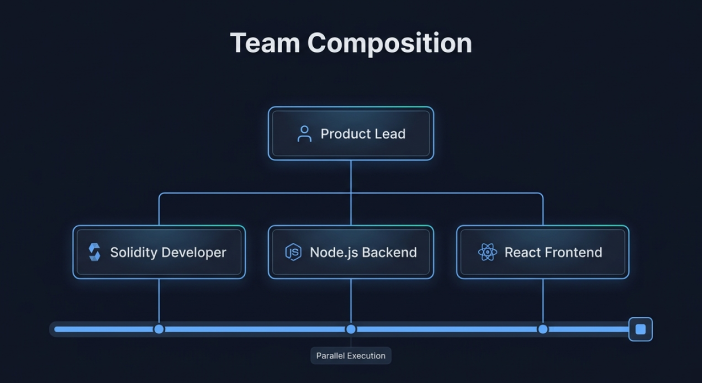
The most common reason a prediction market build takes six months instead of three is a single developer handling everything sequentially.
A minimum viable team for a custom build from scratch is four people working in parallel. One senior Solidity developer handles smart contracts and handles nothing else during the contract phase. One backend developer builds the Node.js API, Redis order book, and PostgreSQL integration while contracts are being written. One frontend developer builds the React interface and wallet integrations while the auditor reviews the contracts. One product lead manages requirements, writes market creation criteria, configures the admin panel, and handles vendor coordination. With four people in parallel, a custom build takes four to five months. With two people working sequentially, it takes eight to ten months.
Offshore development teams reduce daily rates from $150 to $250 per hour (US/EU rates for senior Web3 developers) to $40 to $80 per hour for equivalent quality in Eastern Europe or Southeast Asia. The tradeoff is time zone management and communication overhead. A hybrid approach works well: offshore Node.js and React developers for backend and frontend, with a US or EU-based Solidity developer for the smart contract work where quality variance is most expensive.
Post-Launch: The Timeline Nobody Budgets For
Most founders treat launch as the finish line. It’s the starting line. The first 90 days post-launch typically require 60% to 80% of the development effort that the initial build required. Real users find UI friction your beta didn’t. Oracle resolution edge cases surface on live markets. Settlement bugs appear at scales your testnet never simulated. Admin dashboard workflows turn out to be missing features that your team needs to operate the platform.
Budget one to two developers working full-time on post-launch improvements for the first 90 days, or budget to move them from new feature development to maintenance mode during that period.
Monthly maintenance after the 90-day stabilization period: one part-time Solidity developer for contract changes (each change requires a re-audit of the changed scope), one part-time backend developer for infrastructure updates and monitoring response, and one part-time frontend developer for UI improvements. Budget $5,000 to $12,000 per month in ongoing technical costs, not including oracle fees and infrastructure.
Frequently Asked Questions
Q1: What is the fastest possible timeline to launch a prediction market app?
Two weeks if you’re building on Polymarket’s existing CLOB API. You build the frontend, wallet auth, and order management interface. Six weeks for a production-quality integration-first product live with real user testing. If you need your own contracts and liquidity, the minimum is eight weeks with a clone script, an accelerated audit, and a team working in parallel.
Q2: How long does the smart contract audit add to the timeline?
Four to six weeks total: two to four weeks for the audit engagement itself, plus one to two weeks for remediation if the auditor finds medium or high severity issues. Run Slither and MythX automated scanners before engaging the auditor. This clears common vulnerabilities (missing ReentrancyGuard, incorrect access control) before you’re paying audit rates, reducing the remediation cycle by one to two weeks.
Q3: Why does building a regulated prediction market like Kalshi take 12 to 18 months?
Regulation is the critical path, not development. Corporate structuring, CFTC designation application, regulatory review period, KYC/AML infrastructure, banking relationships for fiat deposits, and compliance audits all happen before or during development. The fiat rail integration alone adds eight to twelve weeks compared to a crypto-native build. Kalshi spent two-plus years getting their CFTC designation before reaching the scale they have in 2026.
Q4: How many developers do I need and what roles?
A minimum viable team for a custom build from scratch is four people in parallel: one senior Solidity developer, one backend developer (Node.js), one frontend developer (React), and one product lead. That team delivers in four to five months. Two developers working sequentially deliver in eight to ten months. For a clone script build, two developers (one Solidity, one full-stack) working in parallel can deliver in six to eight weeks.
Q5: What is scope creep and how do I prevent it during prediction market development?
Scope creep is adding features during development that weren’t in the original specification. A leaderboard, a mobile app, a referral program, a token staking mechanism — each adds one to three weeks. Lock an MVP specification before development starts and schedule every non-MVP feature for a defined version two. Any feature requested during development that wasn’t in the spec goes on the roadmap and nothing gets built until the MVP ships.
Q6: How long does liquidity bootstrapping take and when does it start?
Start liquidity bootstrapping four to six weeks before public launch, during your closed beta. Seed each AMM market with $5,000 to $15,000 in operator capital. Run a closed beta with 200 to 500 invited users to generate trading activity before organic users arrive. The bootstrapping period itself is on your critical path to a launch that doesn’t feel empty, even though it’s not development work.
Q7: What’s the total cost of a prediction market build including post-launch?
Integration-first: $15,000 to $40,000 upfront, $2,000 to $5,000 per month post-launch. Clone script: $10,000 to $50,000 upfront plus $12,000 to $25,000 for your own audit, $5,000 to $10,000 per month. Custom build: $80,000 to $180,000 upfront plus audit, $8,000 to $15,000 per month. Regulated platform: $300,000 to $800,000 upfront plus legal, $20,000 to $50,000 per month. The post-launch number is where most founders are surprised. Budget it before you commit to the build.