Prediction markets hit $64 billion in trading volume in 2025. By January 2026, monthly run-rates crossed $27 billion, putting the full-year figure on track to pass $325 billion. That’s not a niche anymore. So founders are paying attention, and most of them search “prediction market script” expecting something like a Shopify theme. Grab it, deploy it, go live by Friday. That’s not how this works.
The script is maybe 40% of what gets you to launch. The other 60% is the decisions you make before you write a single line of code or sign a deployment key. Which trading engine. Which chain. Which oracle. Whether you need an audit before or after your beta. Most vendors won’t tell you this because they want you to commit to the purchase first.
This guide covers what’s actually inside a prediction market script, what everything costs including the parts nobody quotes you upfront, and a realistic 30-day launch roadmap.
What’s Actually Inside a Prediction Market Script
Not all scripts are the same. Some vendors sell you a frontend with basic market creation and call it a platform. Here’s what a production-grade script should actually include.
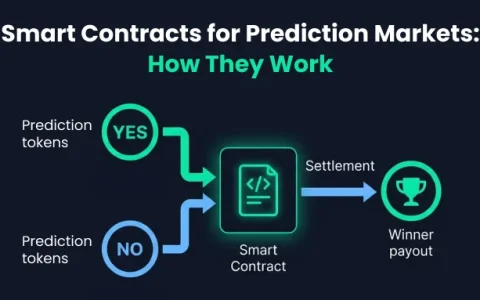
Smart contracts handle market creation, position tracking, and settlement. They should be written in Solidity for EVM chains, already audited, and modular enough for you to add market types without rewriting the base logic. If a vendor’s contracts aren’t upgradeable or they can’t produce a third-party audit report, that’s your signal to walk away.
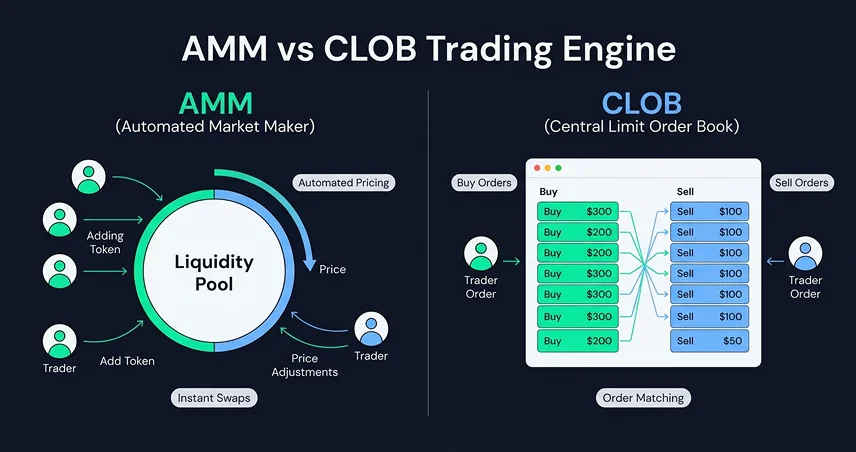
The trading engine is either AMM (automated market making) or CLOB (central limit order book). This single decision shapes your entire architecture, your audit scope, and your liquidity strategy. More on this below.
Oracle integration connects your platform to real-world data. Chainlink is the standard. Without reliable oracle feeds, you can’t settle markets accurately, and a bad settlement on a $200,000 pool gets you sued or forked by your own users.
Admin panel should cover market creation and scheduling, user management, fee configuration, dispute resolution workflows, and analytics. One team we worked with launched without a dispute resolution workflow. Their first contested market took 11 days to settle manually. Users left and didn’t come back.
Wallet integration means MetaMask and WalletConnect for desktop, mobile wallet connectors for iOS and Android. Non-custodial by default. You don’t want to hold funds. Ever.
Stablecoin settlement in USDC is what most serious platforms use in 2026. USDT works too, but USDC has cleaner regulatory footing and better Layer 2 liquidity on Polygon. Pick USDC if you’re building for a global audience.
You can explore a white-label prediction market with source code to see what a complete script package looks like before committing to a vendor.
AMM or CLOB: The Trading Engine Decision That Eats Your Budget
This is where most founders get burned. They pick the wrong engine for their stage and spend $15,000 to $40,000 fixing it six months later.
AMM (automated market making) uses liquidity pools and algorithmic pricing. You don’t need a counterparty to fill an order. The pool provides liquidity. This is what you want at launch when you have zero to moderate trading volume. It’s cheaper to build, cheaper to audit, and it works without a deep order book. Polymarket launched and scaled on AMM liquidity. So did most successful prediction platforms you’ve heard of.
CLOB (central limit order book) is a traditional exchange model. Buyers and sellers match orders directly at agreed prices. It gives traders better price discovery and tighter spreads, but it needs real volume to function. Below about 1,000 active daily traders, a CLOB feels empty. Orders sit unfilled for hours. Users assume the platform is dead and stop coming back.
Start with AMM. Add CLOB functionality after you’re consistently past 2,000 daily active users. The vendors who pitch you CLOB from day one are charging you for complexity you don’t need yet. And the audit bill for a CLOB smart contract runs about $8,000 to $12,000 more than an AMM equivalent.
| AMM — Start Here | CLOB — Add Later |
|---|---|
| Uses liquidity pools and algorithmic pricing | Buyers and sellers match orders directly at agreed prices |
| No counterparty needed to fill an order | Better price discovery and tighter spreads |
| Cheaper to build and cheaper to audit | Audit costs $8,000–$12,000 more than an AMM equivalent |
| Works at low volume — ideal for launch | Needs 1,000+ active daily traders to feel alive |
| Polymarket launched and scaled on AMM liquidity | Add after you’re past 2,000 consistent daily active users |
| Watch out: Vendors pitching CLOB from day one are charging you for complexity you don’t need yet. The audit bill for a CLOB smart contract runs $8,000 to $12,000 more than an AMM equivalent — before your platform has a single real user. |
Binary, Scalar, and Categorical Markets: Pick the Right One for Your Niche
Binary markets have two outcomes: yes or no. “Will Bitcoin close above $100,000 by December 31?” Most starter prediction platforms launch binary-only because the smart contract logic is simpler and audits cost less. If your budget is under $35,000 total, start here.
Scalar markets have continuous outcomes across a numeric range. “What will Bitcoin’s closing price be on December 31?” These need more complex oracle configurations and settlement logic. The audit bill goes up roughly $5,000 to $8,000 more compared to binary-only. Good for financial prediction platforms where users want precise outcome tracking.
Categorical markets have multiple discrete outcomes. “Who will win the 2026 World Cup?” This adds complexity in the UI and in liquidity allocation since funds spread across multiple outcome pools. Sports and political markets typically use categorical structures. They’re also harder to settle cleanly because you need oracles that confirm specific real-world results, not just price data.
For an MVP, start binary. Add scalar and categorical in version two once you know your user base, their prediction habits, and which market types they actually trade.
The Real Cost Breakdown: Script, Audit, and 90-Day Post-Launch Budget
Most vendors quote development cost and stop there. Here’s what the full budget actually looks like.
| Cost Item | Range | Notes |
|---|---|---|
| White-label script | $8,000–$30,000 | Source code ownership, branding, fee config, one round of integration support |
| Smart contract audit | $10,000–$25,000 | Certik, Hacken, or Trail of Bits. Not optional — one reentrancy bug cost one platform $80K in user funds |
| Chainlink oracle (monthly) | $500–$2,000/mo | Depends on number of price feeds and update frequency on Polygon |
| Polygon deployment | $300–$600 one-time | Per-trade gas costs for users under $0.01 |
| Post-launch, first 90 days | $3,000–$8,000/mo | Infrastructure, oracle fees, community management, bug bounties, UI fixes |
| Total minimum viable budget | $25,000–$35,000 | Script + audit + deployment + 90-day ops |
Do not skip the audit. One platform we know of skipped their pre-launch audit to save $14,000. Three months post-launch, a reentrancy bug in their withdrawal function cost them roughly $80,000 in user funds. The audit cost looks very different after that conversation.
Blockchain and Oracle Setup: Polygon, Chainlink, and the Decisions That Matter
Polygon is the right default for most prediction market startups in 2026. It’s EVM-compatible so your Solidity contracts work without changes. Gas fees are low enough that a $10 prediction doesn’t cost $3 in fees. And Chainlink has full oracle support on Polygon mainnet, which matters because you need reliable price feeds from day one.
Ethereum mainnet is still the gold standard for smart contract security and decentralization, but gas costs make small-stake predictions economically painful for regular users. A prediction market where users think twice about placing a $20 bet isn’t a prediction market, it’s a gas price simulator.
Binance Smart Chain is cheaper but comes with more centralization concerns and a more complicated regulatory profile in 2026. If you’re building for any audience with US users, Polygon is a cleaner choice on both cost and optics.
For Chainlink, you’re using two things: Data Feeds for financial market prices (crypto, indices), and Chainlink Any API for custom event outcomes like sports results or political events. The Data Feed integration takes a few days. Any API takes closer to two weeks to configure and test reliably. Budget both in your Week 2 timeline.
Your 30-Day Launch Roadmap
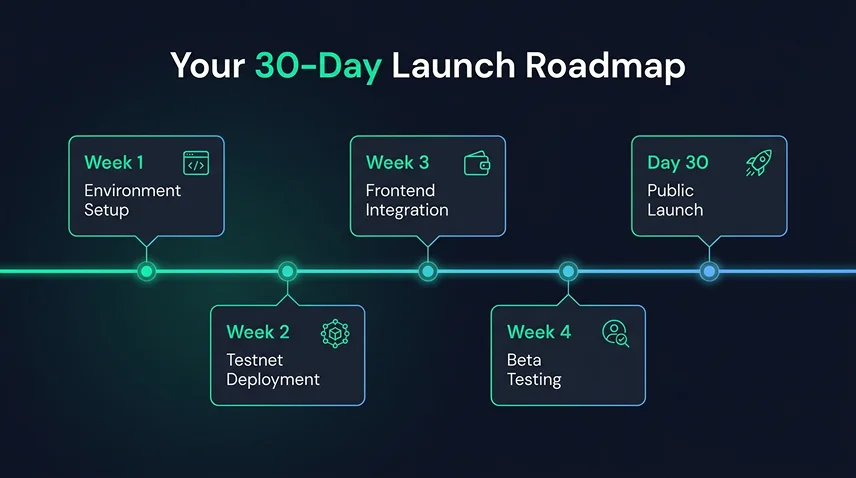
This assumes you’ve signed with a white-label vendor and received source code. The clock starts on handoff day.
Week 1 — Environment setup and code review. Get your Node.js and Laravel backend running locally. Have your developer or a freelance Solidity reviewer walk through the smart contracts. Identify customization gaps: market categories, fee structures, branding. Surprises in Week 1 cost a day. Surprises in Week 3 cost your launch date.
Week 2 — Polygon testnet deployment and Chainlink integration. Deploy contracts to Polygon Mumbai testnet. Wire up Chainlink Data Feeds. Run at least 50 simulated market creation and settlement cycles across different market types. Fix anything that breaks before it costs real gas.
Week 3 — Frontend integration and admin panel configuration. Connect MetaMask and WalletConnect. Configure your admin panel fee tiers and market categories. Set up your first five live markets on testnet starting with crypto price predictions, since they use the simplest Chainlink feeds. Enable USDC deposits and withdrawals and stress test the flow end-to-end.
Week 4 — Soft launch and monitoring. Invite 200 to 500 beta users from your network or a small community waitlist. Watch real settlement behavior on live markets. Set up Polygon monitoring alerts. Fix UI friction you didn’t catch in testing. Don’t market heavily yet. You want real users to break things before you scale.
Day 30: public launch with active markets, a working referral program, and your first leaderboard cycle running.
How to Actually Make Money: Prediction Market Revenue Models
Transaction fees are the foundation. Most platforms charge 1% to 3% on winning payouts or on total volume traded. At $1 million in monthly volume, that’s $10,000 to $30,000 in monthly revenue before infrastructure costs.
Market creation fees work when you open the platform to external users creating their own prediction markets. Charge $50 to $200 per market depending on scope and settlement complexity.
Staking rewards pull in liquidity providers. Users lock tokens to earn a share of platform fees. This deepens your AMM liquidity pools, which tightens pricing, which attracts more active traders. One platform tracked here saw a 35% increase in daily trading volume within 30 days of launching a staking program.
Referral programs with on-chain tracking convert well in Web3 communities. Paying 5% to 10% of referred user fees back to the referrer is a reasonable starting structure. Better than UTM links because the payout is automatic and users trust it.
NFT badges and leaderboards are not just engagement gimmicks. Platforms running weekly prediction leagues with NFT rewards see retention rates about 40% higher than those without. Because they’ve built a reason for the user to come back on Tuesday.
Don’t try to launch all of this at once. Start with transaction fees and a referral program. Add staking after your liquidity pools show clear demand. Add NFT rewards after you have enough users to make the leaderboard feel competitive.
Frequently Asked Questions
Q1: What’s the difference between a prediction market clone script and a white-label prediction market?
A clone script is a raw copy of an existing platform’s codebase, often sold cheaply with minimal support and little to no audit. A white-label solution is a licensed, configurable platform where you get branding rights, integration support, and often one included audit cycle. For a production launch handling real user funds, white-label is the only serious option.
Q2: Do I need a smart contract audit before launching?
Yes, without exception. Without an audit, you carry liability for every vulnerability in your settlement and withdrawal contracts. Budget $10,000 to $25,000 from a firm like Certik, Hacken, or Trail of Bits. Skipping this is not a cost-saving measure. It’s a deferred disaster.
Q3: How much does Chainlink oracle integration cost?
Chainlink Data Feeds on Polygon run roughly $500 to $2,000 per month depending on the number of active price feeds. Custom event outcome feeds via Chainlink Any API require additional developer time — budget 2 weeks — and ongoing LINK token payments. Total first-year oracle cost typically lands between $8,000 and $20,000.
Q4: Can I launch a prediction market without KYC and AML compliance?
It depends on your jurisdiction and your user base. In 2026, platforms accepting users from regulated markets and handling real money face increasing regulatory pressure. Most platforms use Sumsub or Onfido for KYC at around $1 to $3 per verified user. Skipping compliance is a legal risk, not a development shortcut. And it becomes a much bigger problem once you have $5 million in trading volume and a regulator asking questions.
Q5: What’s the minimum viable budget to launch a prediction market in 2026?
Around $25,000 to $35,000. That covers a white-label script ($8,000 to $15,000), a basic smart contract audit ($10,000 to $15,000), Polygon deployment and Chainlink setup (around $1,500), and 90 days of infrastructure ($3,000 to $8,000). Below this range, you’re either skipping the audit or launching on a platform you don’t fully own or understand.
Q6: Why choose Polygon over Ethereum mainnet?
Gas fees on Ethereum mainnet make small predictions economically unviable for most users. A $10 prediction with $3 in gas fees isn’t a product anyone keeps using. Polygon gives you full EVM compatibility — your Solidity contracts work without changes — at a fraction of the cost. Per-trade gas fees on Polygon stay under $0.01, which keeps small-stakes markets accessible to everyone.
Q7: What prediction market types perform best at launch?
Crypto price predictions have the lowest friction because Chainlink price feeds are instant, users already understand the context, and binary market logic is clean. Sports and political markets attract broader audiences but need more complex oracle configurations and carry higher regulatory scrutiny depending on your users’ jurisdictions.