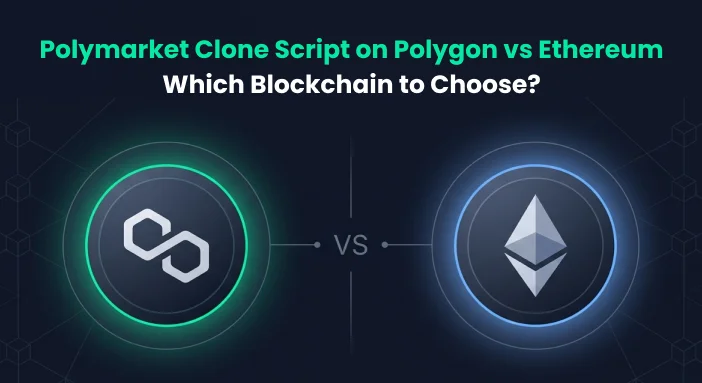
Most Polymarket clone script vendors list “Ethereum, Polygon, and BSC” as supported blockchains and leave the decision to you. That’s not guidance. That’s a dropdown menu. The blockchain you deploy on sets your gas cost floor, determines which oracle providers are available, shapes the developer pool you can hire from, and controls your long-term migration risk. If you deploy on Ethereum mainnet, a $10 trade will generate more in gas fees than the trade itself earns the user. If you deploy on Polygon PoS, you’re building on the same chain Polymarket is in the process of leaving. If you deploy on Arbitrum or Base without understanding the sequencer centralization trade-off, you may get surprised during a regulatory enforcement action or a chain-level incident. This guide covers what each chain actually means for a prediction market clone deployment in 2026, with specific numbers.
At a Glance: Blockchain Comparison for Prediction Market Clones
| Chain | Gas / Trade | Oracle Support | Best For | Key Risk |
|---|---|---|---|---|
| Ethereum Mainnet | ~$0.44 | Full | Institutional, high-value markets | Gas kills small-stake retail users |
| Polygon PoS | ~$0.002–$0.008 | Full | MVP launch, 0–18 months | Polymarket migration signal |
| Polygon zkEVM | ~$0.01–$0.03 | Chainlink partial | Scale after Polygon PoS | Fewer DeFi integrations |
| Arbitrum One | ~$0.005–$0.03 | Full | DeFi-adjacent markets, growth phase | Centralized sequencer |
| Base | ~$0.001–$0.01 | Chainlink full, UMA partial | Coinbase users, retail-first | Ecosystem youth, centralized seq. |
Why Ethereum Mainnet Is the Wrong Choice for Consumer Prediction Markets
Ethereum mainnet is the most secure, most decentralized, and most audited EVM environment. It is also the wrong chain for a consumer prediction market where users are trading $10 to $100 per position.
A standard Ethereum mainnet transaction costs approximately $0.44 in gas. A binary market trade typically requires two to three contract interactions: token approval, the buy or sell call, and in some cases a position split. That’s $0.88 to $1.32 in gas on a $10 trade — a 9% to 13% gas tax on top of the platform’s trading fee. No retail user accepts this. The same trade on Polygon PoS costs $0.002 to $0.008. On Arbitrum, $0.005 to $0.03. On Base, under $0.01 in most conditions.
Ethereum mainnet is the right chain if your prediction market targets institutional participants placing positions of $500 or more, where a $1.50 gas fee is under 0.3% of the trade value. For everyone else, deploy on an L2 or sidechain.
For the full build guide covering chain selection in context, see how to build a prediction market platform like Polymarket.
Polygon PoS: Why Polymarket Chose It and Why That’s Changing
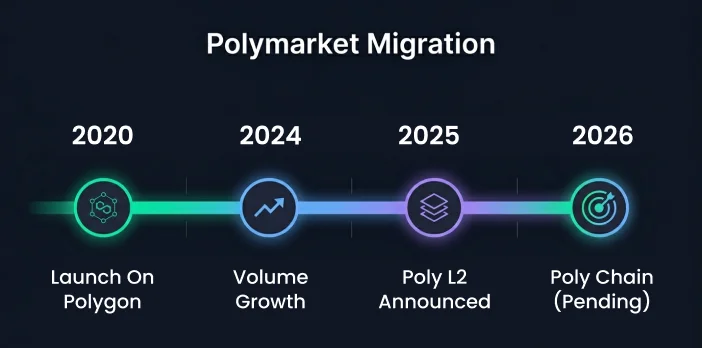
Polygon PoS is an EVM-compatible sidechain with its own proof-of-stake consensus. Transactions run at 2 to 3 second block time, cost $0.002 to $0.008 per trade, and the developer tooling ecosystem is the most mature of any EVM alternative chain. Polymarket deployed on Polygon PoS in 2020 and rode that infrastructure to $21 billion in monthly trading volume by early 2026. The Gnosis Conditional Tokens Framework — the ERC-1155 outcome token standard — is fully deployed and audited on Polygon. Chainlink Data Streams and UMA’s Optimistic Oracle both have full Polygon support.
The complication is signal, not mechanics. In December 2025, Polymarket listed building its own Ethereum Layer 2 — internally called POLY — as its top infrastructure priority. The POLY chain had not launched as of March 2026. This is a ceiling signal, not an immediate problem. Polygon PoS works fine for the next 12 to 18 months of a new platform’s life. But your architecture should assume you’ll migrate, and your smart contracts should be written with chain portability in mind from day one.
Practically: avoid Polygon PoS-specific precompiles that don’t exist on other EVM chains. Keep your oracle integration in a wrapper contract that can be repointed without changing your core market logic. Use Alchemy’s multi-chain RPC service rather than a Polygon-only node provider. These decisions cost nothing at build time and save $10,000 to $30,000 in rewrite costs if you migrate later.
Polygon zkEVM: The Upgrade Path and Its Trade-offs
Polygon zkEVM is a zero-knowledge rollup that settles to Ethereum mainnet using cryptographic proofs. It is EVM-equivalent — Solidity contracts compiled for mainnet deploy without changes. Gas costs are comparable to Polygon PoS ($0.01 to $0.03 per trade), but with stronger security guarantees because settlement finality is anchored to Ethereum L1.
The practical trade-offs for a prediction market deployment in 2026 are real. Chainlink’s full Data Streams product is not yet uniformly available on Polygon zkEVM — you may need to fall back to Data Feeds, which use a heartbeat-based update model that creates a manipulation window around settlement. UMA’s Optimistic Oracle has limited zkEVM support compared to its Polygon PoS deployment. The DeFi ecosystem on zkEVM is smaller, which matters when sourcing liquidity providers and building DeFi integrations.
Polygon zkEVM is the right migration target for a platform that started on Polygon PoS and needs stronger Ethereum settlement guarantees at scale. It is not the right starting chain for an MVP. Build on Polygon PoS. Evaluate zkEVM at the 18-month mark when your volume justifies the stronger security model.
Arbitrum One: The DeFi-Native Alternative
Arbitrum One is an optimistic rollup that settles to Ethereum mainnet. Its total value locked exceeded $2.4 billion in early 2026, making it the dominant DeFi Layer 2 by TVL. Gas fees average $0.005 to $0.03 per transaction after the Dencun upgrade and EIP-4844 blob pricing. Chainlink Data Streams has full Arbitrum support. UMA’s Optimistic Oracle has full Arbitrum support including DVM dispute resolution. For a prediction market that overlaps with DeFi use cases — crypto price markets, protocol governance outcome markets, DeFi yield rate prediction — Arbitrum’s existing DeFi ecosystem provides a built-in user base and liquidity context that Polygon PoS doesn’t match.
The honest trade-off is sequencer centralization. Arbitrum One’s sequencer is operated by Offchain Labs. A centralized sequencer can theoretically censor transactions, impose ordering preferences, or experience downtime. For prediction markets specifically, the most relevant risk is settlement-time transaction reordering: if the sequencer can reorder transactions around oracle settlement events, MEV extraction at settlement time is more concentrated. Use commit-reveal schemes for large redemptions and rate-limit withdrawal amounts per block as countermeasures.
Arbitrum is the recommended chain for prediction market platforms building past the MVP stage, particularly if your market categories include DeFi or financial events, or if you expect to attract algorithmic traders who require order-book-grade infrastructure.
Base: The Coinbase-Backed Retail Chain
Base is an Ethereum Layer 2 built on the OP Stack and incubated by Coinbase. Its fiat onramp via Coinbase’s 110 million verified user base is the chain’s primary competitive advantage for a consumer prediction market. Gas fees average below $0.01 in most conditions. Native USDC issued directly by Circle on Base eliminates the bridge risk associated with wrapped stablecoin versions on other chains. Base’s average daily revenue exceeded $185,000 in 2025, reflecting genuine transaction volume.
The trade-offs: UMA’s Optimistic Oracle does not yet have the same depth of deployment on Base as on Polygon PoS or Arbitrum — verify current UMA support before committing Base for event-based markets requiring DVM dispute resolution. Base’s sequencer is operated by Coinbase, a publicly listed, CFTC-regulated entity. In a regulatory enforcement scenario targeting prediction markets, Coinbase as sequencer operator creates a more direct compliance surface than Offchain Labs.
Base is the recommended chain if your primary user acquisition channel is the Coinbase ecosystem, your users are not crypto-native, and your market categories are sports, politics, or pop culture rather than DeFi-native events requiring deep UMA integration.
Full Chain Comparison: Gas, Oracle Support, and Migration Risk
| Factor | Polygon PoS | Arbitrum One | Base | Ethereum Mainnet |
|---|---|---|---|---|
| Avg gas per trade | $0.002–$0.008 | $0.005–$0.03 | $0.001–$0.01 | ~$0.44 |
| Chainlink Data Streams | Full | Full | Full | Full |
| UMA Optimistic Oracle | Full | Full | Partial | Full |
| CTF (Gnosis) deployment | Full, audited | Full | Partial | Full |
| Developer pool | Largest non-mainnet | Large, DeFi-heavy | Growing | Largest overall |
| Sequencer | Own validators | Centralized (Offchain Labs) | Centralized (Coinbase) | N/A |
| Native USDC | Yes (bridged also) | Yes | Yes (native Circle) | Yes |
| Fiat onramp | Third-party | Third-party | Native Coinbase | Third-party |
| Migration risk | Medium | Low | Low | Low |
| Right for | MVP, 0–18 months | DeFi-adjacent, growth | Coinbase users, retail | Institutional only |
Chain Migration Risk: What It Costs to Switch After Launch
A chain migration is not a redeployment. It’s a rebuild of your settlement infrastructure. Your contracts need to be redeployed and re-audited on the new chain. Oracle integrations need to be reconfigured and retested — provider availability and contract addresses differ per chain. Your The Graph subgraph needs to be rewritten for the new chain’s event structure. Your RPC infrastructure needs to be switched. Your UI’s wallet connection logic needs to handle users on the old chain while directing new users to the new chain. Existing user positions need to be wound down or migrated.
Realistic chain migration budget: $10,000 to $30,000 in development and re-audit costs, plus four to eight weeks of engineering time. For a platform with active user positions in open markets, the migration also requires running two chains simultaneously during the transition — old markets settling on chain A, new markets opening on chain B.
The practical lesson: choose your starting chain assuming you’ll stay on it for at least 18 to 24 months. Write your contracts with portability in mind from day one: avoid chain-specific precompiles, keep oracle integrations in replaceable wrapper contracts, and use multi-chain RPC providers like Alchemy from the start.
Frequently Asked Questions
Q1: Why did Polymarket originally choose Polygon PoS?
Gas economics and ecosystem maturity. In 2020, Polygon PoS offered the only viable combination of low gas (sub-$0.01 per trade), full EVM compatibility, Chainlink oracle support, and a mature enough developer ecosystem. Ethereum mainnet gas costs at the time would have made small-stake prediction trading economically unviable. L2s like Arbitrum and Base either didn’t exist or weren’t mature enough for production prediction market contracts.
Q2: Is Polymarket leaving Polygon and what does that mean for a clone script?
As of December 2025, Polymarket listed building its own Ethereum Layer 2 called POLY as its top infrastructure priority. The chain had not launched as of March 2026. For a clone script deployment, this is a migration signal: Polygon PoS has ceiling limitations at Polymarket’s scale. Polygon PoS is still the right MVP chain for a new platform. But smart contracts should be written with chain portability in mind — avoid Polygon-specific precompiles, keep oracle integrations in replaceable wrapper contracts, and use multi-chain RPC providers like Alchemy from day one.
Q3: What’s the real gas cost difference between Polygon and Ethereum mainnet for prediction market trades?
A binary market trade on Ethereum mainnet costs approximately $0.44 in gas. The same trade on Polygon PoS costs $0.002 to $0.008. On Arbitrum One, $0.005 to $0.03. On Base, under $0.01 in most conditions. For a $10 trade, mainnet gas is 4% to 13% of the trade value. Mainnet becomes acceptable only when average trade sizes exceed $500. Consumer prediction market platforms where users are placing $10 to $100 positions need Polygon, Arbitrum, or Base.
Q4: What’s the difference between Polygon PoS and Polygon zkEVM for a prediction market?
Polygon PoS is a sidechain with its own validator set — fast, cheap, and the most mature oracle and DeFi ecosystem of any Polygon product. Polygon zkEVM is a zero-knowledge rollup that settles to Ethereum mainnet with cryptographic proofs. It offers stronger settlement finality guarantees but has less mature oracle support (Chainlink Data Streams not fully available), fewer audited DeFi integrations, and a smaller developer pool. Deploy on Polygon PoS for your MVP. Evaluate Polygon zkEVM at the 18-month mark if stronger Ethereum settlement guarantees matter for your regulatory strategy.
Q5: Does Arbitrum or Base support UMA’s Optimistic Oracle for event-based prediction markets?
Arbitrum One has full UMA Optimistic Oracle support, including the Data Verification Mechanism (DVM) dispute resolution layer. Base has partial support as of 2026 — verify current deployment status with UMA’s documentation before committing Base as your chain for event-based markets that require UMA dispute resolution. Polygon PoS has the most complete and longest-running UMA deployment and is the safest choice if event-based markets with UMA resolution are core to your product.
Q6: What does sequencer centralization mean for a prediction market on Arbitrum or Base?
Both Arbitrum One and Base use centralized sequencers (Offchain Labs and Coinbase respectively). A centralized sequencer can theoretically censor transactions, reorder them around settlement events to extract MEV, or experience downtime. For prediction markets, the most relevant risk is settlement-time transaction reordering: a centralized sequencer has more ability to front-run large redemption transactions around oracle settlement events. Countermeasures include commit-reveal schemes for large redemptions and rate-limiting withdrawal amounts per block.
Q7: What does a chain migration cost if I need to switch after launch?
$10,000 to $30,000 in development and re-audit costs, plus four to eight weeks of engineering time. This includes contract redeployment and re-audit on the new chain, oracle integration reconfiguration and testing, The Graph subgraph rewrite, RPC infrastructure switch, and UI wallet connection logic updates. If you have active user positions in open markets at migration time, add the cost of running two chains simultaneously during the transition. Build your contracts with portability in mind from day one — avoid chain-specific precompiles and keep oracle integrations in replaceable wrapper contracts.