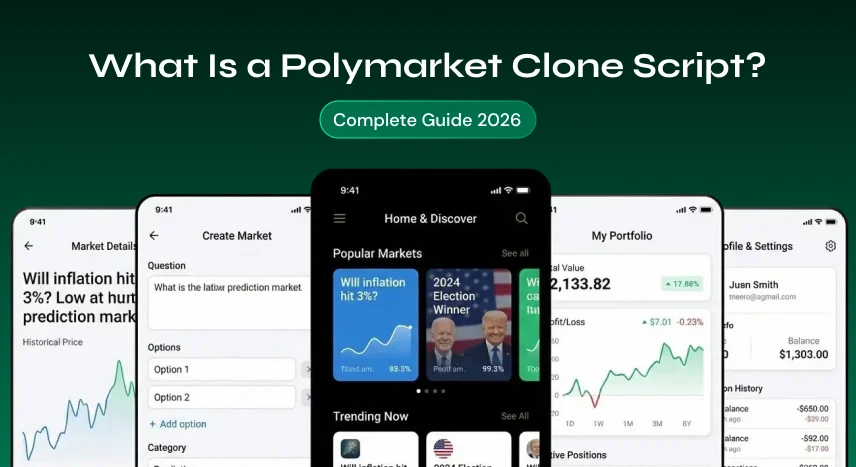
Polymarket processed over $1 billion in trading volume around the 2024 U.S. election cycle alone. That number made a lot of founders stop and reconsider what they were building. Prediction markets aren’t a niche bet anymore. They’re a category with proven demand and growing regulatory clarity.
The fastest way to enter that market isn’t building from scratch. It’s starting with a Polymarket clone script, customizing it for your audience, and deploying in weeks rather than months. This guide covers exactly what that means, what it costs, and where founders consistently make expensive mistakes.
How a Polymarket Clone Script Actually Works
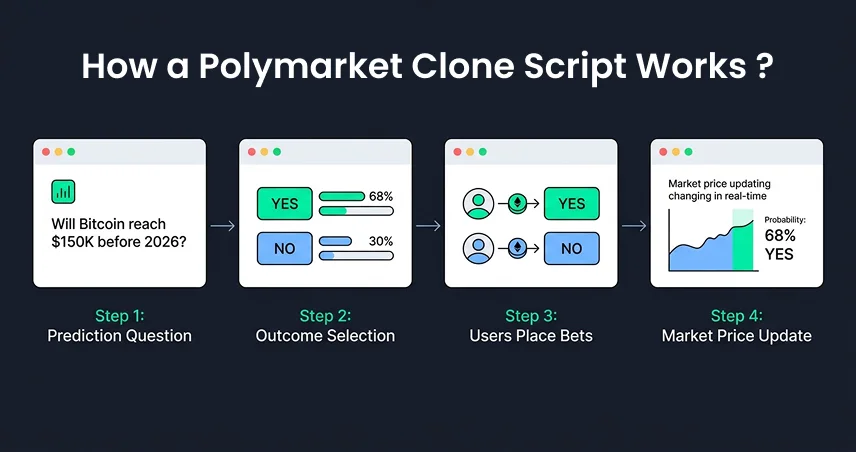
A prediction market lets users buy shares in outcomes. Will Bitcoin cross $150K before the year ends? Will a specific party win a state election? Each outcome is a tradeable position, and the price reflects the crowd’s collective probability estimate in real time.
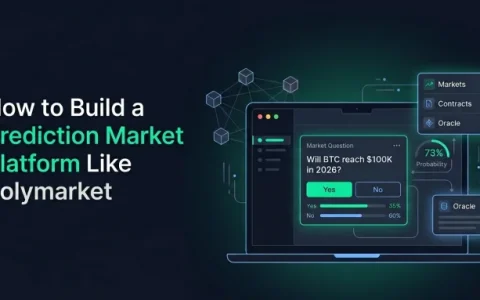
The clone script replicates all of that logic. When you buy one, you’re getting a pre-built system that already handles market creation, AMM-based liquidity pools, wallet integration through MetaMask or WalletConnect, and oracle-based settlement. None of that infrastructure is written from scratch on your end.
Here’s what that means for your timeline. You don’t spend 6 months building a smart contract settlement engine. You spend 4 to 6 weeks configuring, branding, and deploying. That’s the real value of a clone: not the code, but the time it gives back.
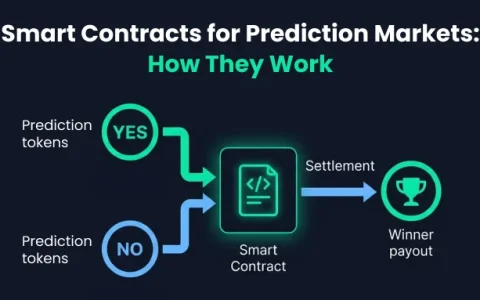
The resolution layer is where most scripts use Chainlink or UMA Protocol to pull real-world data on-chain. A market about a football match result, for example, pulls the final score from an oracle feed. The smart contract reads it and pays out the winning position. No admin clicking a button at 2am. No manual error.
Core Features That Define Your Platform
The basics are table stakes. AMM-based liquidity, USDC or stablecoin markets, Web3 wallet login, a portfolio dashboard, and a live market feed. Any production-ready clone script ships with all of this. What separates a working product from a frustrating one is what sits underneath.
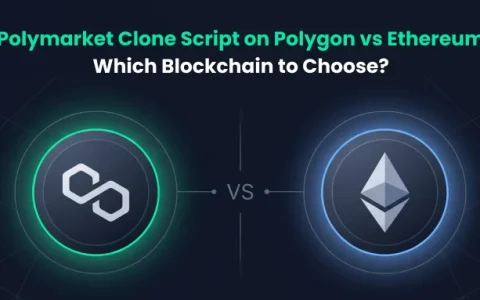
Multi-chain support matters more than most founders expect. If your script only runs on Ethereum mainnet, gas fees make small trades economically pointless for users. Most teams deploy on Polygon or Base today. Some use Arbitrum. Your script needs to support at least one L2 out of the box.
The admin panel is where you actually run the platform day to day. You’ll use it to create markets, set trading fees, approve categories, and flag unusual activity. One team launched with a script that had no bulk market management tools. They were editing markets one by one. At 200 active markets, that became a two-person full-time job.
Market categories that consistently drive volume: politics, sports, crypto, and current events. Starting with two categories and doing them well beats covering six categories poorly. UI/UX customization is non-negotiable. Make sure the frontend is fully decoupled from the smart contract layer so your design team can work without touching Solidity.
The Tech Stack Behind a Production-Ready Clone
Most serious Polymarket clone scripts run on a hybrid architecture. The backend handles API logic, user management, notifications, and admin functions. The blockchain layer handles settlement, liquidity, position minting, and wallet interactions. These two layers talk through APIs, but they’re developed and deployed independently.
Node.js handles real-time WebSocket connections for live market feeds. Laravel works well for the admin REST API and database-heavy operations. Some vendors ship both as separate services.
Smart contracts are written in Solidity and deployed on your chain of choice. If the vendor hands you unaudited contracts, that’s a red flag. Audits run between $5,000 and $25,000 depending on contract complexity and the firm. That cost isn’t optional if you’re handling real user funds.
Oracles pull external data on-chain. Chainlink covers most standard resolution cases. UMA Protocol suits markets with nuanced or contested outcomes. For infrastructure, most teams run on AWS or Google Cloud with Docker-based deployments — budget around $300 to $800 per month at early scale.
Deployment Timeline and What It Actually Costs
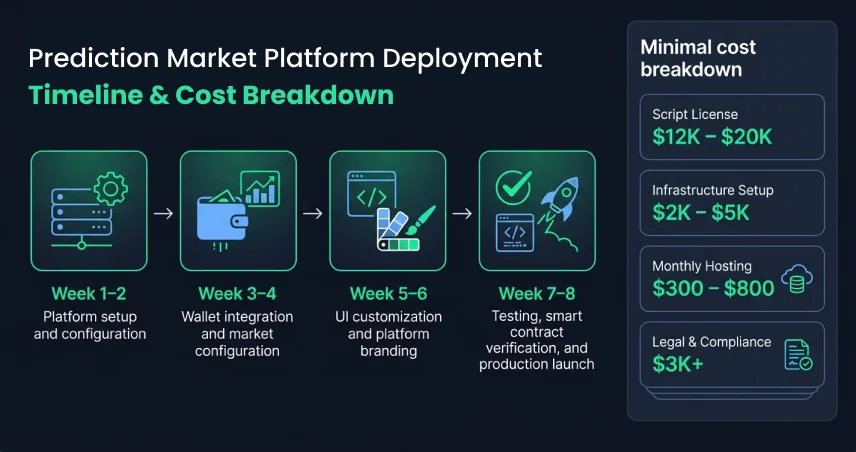
A well-configured Polymarket clone script takes 4 to 8 weeks from purchase to production deployment. That’s assuming you have a developer who knows Web3 and Solidity, or you’re using the vendor’s deployment service.
What extends that timeline: custom UI work adds 1 to 3 weeks. Modifications to smart contract logic add more, plus they require a re-audit of changed code. Scope those before you sign anything.
Typical cost breakdown for a launch-ready platform:
- Script license: $12,000 to $20,000 depending on features and vendor
- Infrastructure setup: $2,000 to $5,000 one-time
- Ongoing hosting: $300 to $800 per month
- Legal and compliance review: varies by jurisdiction, rarely under $3,000
One founder budgeted $20K total and ended up spending $47K by launch. Not because the script was bad, but because they underestimated the audit, the legal review, and a UI overhaul. Build in a 40% contingency. That’s not pessimism. That’s what the data shows.
How the Revenue Model Works
Prediction market platforms generate revenue through trading fees. The standard model charges between 1% and 3% on each trade, taken automatically by the smart contract at settlement. USDC-settled markets make fee collection clean. You don’t invoice anyone. You don’t run reconciliation reports at month end.
The math gets interesting at volume. A 2% fee on $10,000 in daily trading volume is $200 per day. On $500,000 daily volume, that’s $10,000 per day. The unit economics are there from day one.
Some operators add a market creation fee for third-party creators, charging $50 to $200 per market. That adds a revenue stream that doesn’t depend on trade volume and filters out low-quality markets because creators have something at stake.
The founders who scale prediction markets fastest obsess over market quality, not quantity. A user who gets paid correctly within 24 hours of resolution comes back. A user who waits a week and files a support ticket usually doesn’t.
Where Most Founders Get This Wrong
Skipping the audit. Every week, someone launches with unaudited smart contracts because the audit fee feels like overhead. One exploit on a small prediction market in 2023 drained around $900K in user funds. The platform never recovered its reputation. Users don’t give second chances to platforms that lose their money through preventable security failures.
Don’t treat the admin panel as a nice-to-have. If your team can’t create markets quickly, update resolution criteria, or pause a broken market without developer help, you’ll lose operational control exactly when you need it most — which is when something goes wrong at 11pm on a Saturday.
And don’t try to cover every market category from day one. A script that offers politics, sports, crypto, entertainment, and weather is giving you options. It’s not telling you to activate all of them. The platforms that gain traction pick one vertical, build a real audience, and expand from there.
You can explore a Polymarket clone script with multi-chain support, oracle integration, and a configurable admin panel before you commit to any development spend.
Frequently Asked Questions
Q1: What’s the difference between a Polymarket clone script and building from scratch?
A clone script gives you a working codebase on day one. Building AMM pools, oracle integrations, and a smart contract settlement engine from scratch takes 6 to 12 months and north of $150,000 in engineering costs. A clone compresses that to 4 to 8 weeks at a fraction of the budget. The tradeoff is customization depth. You can customize almost everything in a good script, but fundamentally different core mechanics may mean rebuilding more than you bought.
Q2: How long does it take to deploy a Polymarket clone?
A standard deployment with minimal custom UI work takes 4 to 6 weeks. Add custom frontend design and you’re looking at 6 to 8 weeks. Smart contract modifications that require a new audit scope can push that to 10 to 12 weeks. The audit itself typically takes 1 to 3 weeks depending on contract complexity and the firm’s queue. Don’t schedule a launch date until the audit is complete.
Q3: What blockchains does a Polymarket clone script typically support?
Most production-ready scripts support Polygon, Ethereum mainnet, Base, and Arbitrum. Polygon is the most common choice for new launches because gas fees are low enough that small trades remain economically viable for users. Ethereum mainnet is usually reserved for high-value markets where users expect base-layer security. Some scripts are chain-agnostic and let you configure the network at launch.
Q4: Do I need a smart contract audit before going live?
Yes. No exceptions. Unaudited contracts handling real user funds are a liability, not a cost saving. Audit pricing ranges from $5,000 to $25,000 depending on the number of contracts and the firm. Some vendors include a basic audit in their package. If they do, verify the auditor’s name and ask for the full report before you pay.
Q5: How does oracle resolution work in a prediction market?
An oracle is an external data feed that delivers real-world information to a smart contract on-chain. When a market resolves, say a sports match ends, the oracle fetches the result and writes it to the blockchain. The smart contract reads that value and automatically pays out the correct positions. Chainlink handles most straightforward resolution cases. UMA Protocol is better for markets with nuanced or subjective outcomes.
Q6: Can I fully white-label the platform with my own branding?
Yes. You control the domain, logo, color scheme, market categories, fee structure, and front-end copy. The blockchain layer operates independently of the brand. Users see your platform and nothing else. Confirm with your vendor that the frontend and backend are cleanly separated so your design changes don’t require touching contract code.
Q7: What’s a realistic budget for launching a prediction market platform?
Plan for $15,000 to $50,000 to reach a production-ready launch. That covers the script license, smart contract audit, infrastructure setup, and basic UI customization. Legal and compliance review adds cost depending on your jurisdiction. Ongoing costs after launch run $300 to $1,000 per month in hosting before you factor in team time. Build in a 40% buffer on your initial estimate — most founders who don’t, regret it.