Most prediction market clone script vendors quote you something between $10,000 and $50,000. What they don’t quote you is the audit you still need, the oracle fees running every month, the re-audit cost when you modify the contracts, and the leverage a vendor holds if your source code never fully transfers to you. The $64 billion that moved through prediction markets in 2025 created a wave of vendors selling scripts. Some are excellent. Some will take your deposit and deliver code that fails the first audit you commission. This guide gives you the framework to tell the difference before you pay anyone a dollar.
What a Production-Grade Clone Script Actually Includes
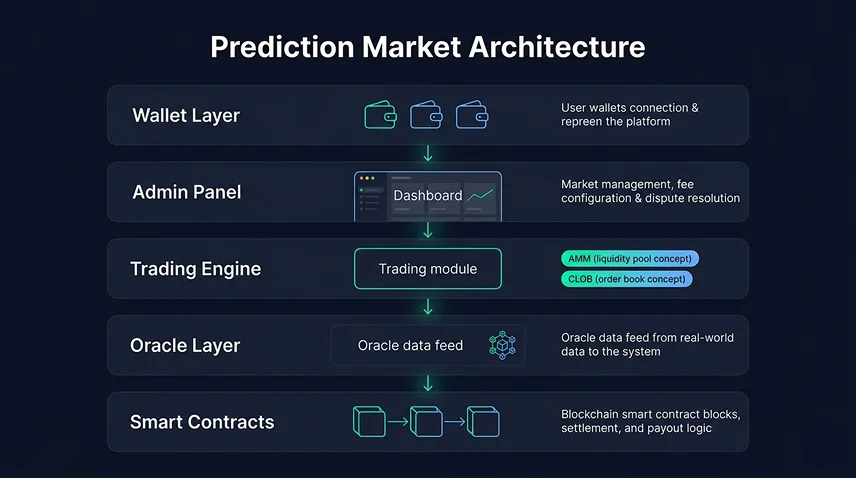
Vendor sales pages are not specific. Here’s what a production-grade script should actually contain, component by component.
Smart contracts cover market creation, position tracking, automated settlement, and payout logic. They should be written in Solidity for EVM-compatible chains (Polygon, Base, Arbitrum), upgradeable where needed, and backed by a named audit from Certik, Hacken, Trail of Bits, or an equivalent firm. If a vendor can’t produce the report and tell you which firm ran it, you’re buying unaudited code.
The trading engine is either AMM or CLOB. AMM uses liquidity pools and algorithmic pricing, works at low volume, and is right for every new platform. CLOB matches buyers and sellers directly and needs real daily trading activity to function. One founder deployed a CLOB engine with 180 active users at launch. Orders sat open for hours. Users assumed the platform was dead and left. Start AMM. Add CLOB after you’ve proven volume above 2,000 daily active traders.
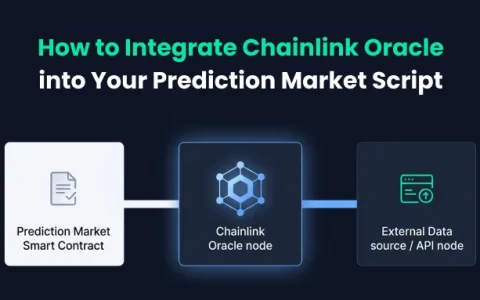
Oracle integration is how your contracts pull real-world outcomes on-chain. Chainlink Data Feeds handle crypto price markets cleanly. Chainlink Any API handles custom events like sports results or election outcomes. Budget two additional weeks for Any API configuration — it’s never plug-and-play regardless of what the vendor’s timeline says.
The admin dashboard should let your team create and close markets, configure fee tiers, trigger settlement, and handle disputed outcomes without touching code. We’ve seen platforms launch without a dispute workflow. Their first contested market went unresolved for nine days while a developer patched a fix at 11pm. That’s a product oversight, not a technical failure — and it cost them their first real user cohort.
Wallet integration covers MetaMask and WalletConnect for desktop and mobile wallet connectors for iOS and Android. Non-custodial by design. You don’t want to hold user funds. Ever.
You can explore a white-label prediction market clone script to see what a complete package looks like before committing to a vendor.
Polymarket vs Kalshi vs Augur: Choosing the Right Model for Your Niche
The model you clone determines your compliance posture, your user acquisition strategy, and how you structure liquidity. Not all clone scripts are the same kind of platform.
Polymarket model. Decentralized, AMM-based, USDC-settled, deployed on Polygon. Geo-restricts US users following a 2022 CFTC settlement. Right for crypto-native international audiences. Fastest to deploy, lowest compliance overhead. If your users are already in Web3 and you don’t need US access, this is your fastest path to a testable product.
Kalshi model. Centralized, CFTC-regulated, and legal for US real-money event contracts. Requires KYC for all users, fiat deposit support, and compliance infrastructure adding roughly $5,000 to $15,000 to your pre-launch setup cost. Right for founders targeting US mainstream audiences who want legal certainty. Wrong for founders who need to be live in 60 days on a tight budget.
Augur model. Fully decentralized, permissionless, on-chain governance. No single entity controls market creation or resolution. Suits founders whose pitch is trustless, censorship-resistant forecasting. It’s the hardest to operate and monetize. Augur’s own volumes have stayed thin because permissionless markets attract adversarial behavior and need active curation.
Manifold Markets model. Free-to-play, no real money, community prediction markets. Not a revenue vehicle, but useful for corporate forecasting tools, internal product validation, or audience engagement platforms.
For most startup founders in 2026, a Polymarket-model clone on Polygon or Base is the fastest path to a testable product. If you’re raising Series A and targeting US institutional users, the Kalshi compliance model is worth the extra setup cost.
| Model | Structure | Chain | US Legal | Best For |
|---|---|---|---|---|
| Polymarket | Decentralized, AMM | Polygon / ETH | No (geo-blocked) | Crypto-native, global audiences |
| Kalshi | Centralized, CLOB | Off-chain | Yes (CFTC) | US mainstream, institutional |
| Augur | Decentralized, DAO | Ethereum | Unclear | Permissionless forecasting |
| Manifold | Centralized, free-to-play | Off-chain | Yes | Community tools, MVPs |
The Vendor Evaluation Framework
Most founders sign a clone script contract after a 30-minute demo call. That’s the wrong process. Ask every vendor these questions before you pay a deposit.
Does source code delivery happen at project completion or on a rolling subscription? Vendors who delay source code delivery until after launch have leverage they shouldn’t have. Full source code for all contracts, backend, and frontend should transfer to you when the project closes, not drip out on a monthly payment schedule.
Can you share the smart contract audit report with the auditor’s name? Ask for the PDF. Check the auditor’s website to confirm the engagement is listed. One founder paid $22,000 for a “fully audited” script and discovered only the deposit function had been scoped. Withdrawal and settlement contracts had never been touched. The audit was real. The scope was not.
What does re-audit cost when I modify the contracts? You will modify the contracts. A re-audit of changed code runs $5,000 to $15,000. Some vendors price this in. Most don’t mention it at all.
Who owns the IP after delivery? This belongs in the contract, explicitly. If the vendor retains any rights over the codebase they deliver, you can’t fork, license, or sell without their permission. That’s not ownership.
Can I speak with two clients who launched with this script? Any credible vendor can produce references. If they offer written testimonials instead of live introductions, treat that as a signal.
Red Flags That Tell You to Walk Away
SaaS-only delivery. If the vendor offers platform access rather than source code, you’re renting. When your needs outgrow their roadmap or their business closes, you lose everything. Walk away.
“Audit included” without documentation. Ask which contracts were in scope, which firm ran it, and when. Vague answers mean the audit is marketing copy, not a real security review.
No milestone-based payment structure. Reputable shops tie payments to deliverables: architecture review, testnet deployment, audit cleared, mainnet live. A single upfront payment with no checkpoints is how you fund a disappearance.
Vendor dependency clauses in the contract. Some agreements require ongoing monthly fees to maintain platform access or receive security patches. If the platform stops working when you stop paying, you didn’t buy a product — you’re locked into a subscription.
Identical platforms across clients. Ask for two references and visit both platforms. If the UI, market categories, and feature set are nearly identical under different logos, you’re getting a template, not a customized build.
Total Cost of Ownership: What Nobody Quotes You
The clone script price is the smallest item on your actual 12-month budget. Here’s what the full cost looks like.
| Cost Item | Range | Notes |
|---|---|---|
| Clone script + customization | $10,000–$50,000 | Varies by vendor, feature scope, and UI customization depth |
| Your own smart contract audit | $10,000–$25,000 | Required even if vendor’s audit exists — your mods create new attack surfaces |
| Re-audit after modifications | $5,000–$15,000 | Any contract change requires a new scoped audit before going live |
| Chainlink oracle feeds (monthly) | $500–$2,000/mo | Depends on number of active markets and update frequency on Polygon |
| Hosting infrastructure (monthly) | $300–$800/mo | AWS or equivalent; scales with user traffic |
| KYC/AML provider | $1–$3 per verified user | Sumsub or Onfido; required for regulated or fiat-accepting platforms |
| Legal review pre-launch | $3,000–$10,000 | Jurisdiction-specific; higher if you need a CFTC opinion |
| Liquidity bootstrapping | $5,000–$20,000 | Seed AMM pools in first 90 days — skip this and your platform feels dead |
| 12-month TCO (realistic) | $60,000–$120,000 | Full picture including ops, not just development |
Founders who budget $25,000 and expect profitability in month three are the ones calling us in month six asking what went wrong. Build in the full number before you commit.
Your Phased Launch Strategy: MVP First, Features Second
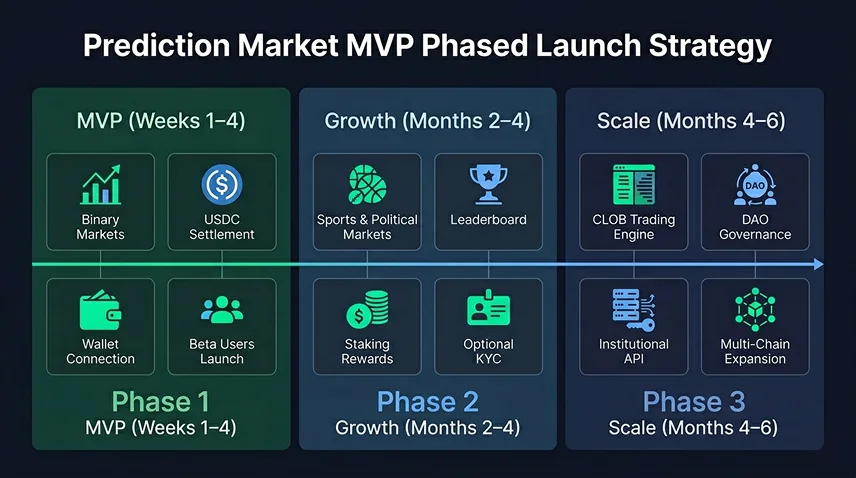
Platforms that launch with binary markets, three to five event categories, and a referral program consistently outperform platforms that launch with ten market types, a governance token, and a staking program no early user understands.
Phase 1 — weeks one through four: MVP only. Binary markets. USDC settlement. Crypto price predictions as your first five live markets — they use the simplest Chainlink Data Feed integration and settle cleanly. MetaMask and WalletConnect connected. Admin dashboard fully configured before launch, not after. Referral program live from day one. Invite 200 to 500 beta users before going public.
Phase 2 — months two through four: Add proven demand. Categorical markets for sports and political events. A leaderboard. Staking rewards once your liquidity pools show consistent depth. KYC if your jurisdiction or user base requires it.
Phase 3 — months four through six: Earned upgrades only. CLOB trading engine if daily active users have cleared 2,000. DAO governance if your community is engaged enough to actually vote. Additional chain deployment if Polygon gas costs are creating real friction for your users.
Everything in Phase 3 should be validated by Phase 2 metrics. Not assumed.
Revenue Setup From Day One
Get one revenue stream working cleanly before you add another.
Transaction fees are the foundation. A 1% to 2% fee on winning payouts is standard. At $500,000 in monthly trading volume, that’s $5,000 to $10,000 in monthly revenue before costs. The unit economics work. The question is always time-to-volume, which depends on your liquidity depth and market quality.
Market creation fees work once external users start requesting their own markets. Charge $50 to $150 per market. It filters out low-quality submissions and builds a revenue stream independent of trading activity.
Referral programs with on-chain tracking convert better in Web3 because users trust the payout is automatic. Start at 5% of referred user fees going back to the referrer.
Staking comes last. It’s operationally complex and requires a working token economy. Build it after you’ve validated trading volume, not before. Founders who launch staking on day one with no trading activity are paying out yield on an empty platform.
Frequently Asked Questions
Q1: What’s the real difference between a Polymarket clone and a Kalshi clone?
Polymarket operates a decentralized, AMM-based platform that geo-restricts US users following a CFTC settlement in 2022. A Polymarket clone suits crypto-native international audiences. Kalshi is CFTC-regulated, US-legal, centralized, and requires full KYC. A Kalshi-model clone adds $5,000 to $15,000 in compliance setup cost but gives you legal access to US users paying with fiat.
Q2: Do I need my own smart contract audit if the vendor already ran one?
Yes. Any modification you make to the vendor’s contracts creates new attack surfaces outside the original audit scope. Budget $10,000 to $25,000 for your own audit from a named firm before you go live with real user funds. This is not a nice-to-have. It’s the line between protecting your users and gambling with their deposits.
Q3: What is vendor lock-in and how do I avoid it?
Vendor lock-in happens when you don’t receive full source code, when contracts have proprietary dependencies you can’t replicate independently, or when ongoing platform access requires continued payment. Avoid it by demanding complete source code delivery in the contract, confirming all dependencies are open-source or licensable, and making IP ownership explicit before you sign.
Q4: Can a prediction market clone script operate legally in the US?
A Polymarket-model decentralized clone is not currently compliant for US users under CFTC guidance. A Kalshi-model platform with CFTC registration and full KYC/AML compliance can operate legally in the US. Get a legal opinion specific to your structure before you build. The cost ($1,500 to $3,000) is nothing compared to a regulator shutting down your platform 90 days after launch.
Q5: What’s the minimum realistic budget to launch?
The script is $10,000 to $50,000. Add $10,000 to $25,000 for your own audit, $1,500 for Polygon deployment and Chainlink setup, and $3,000 to $8,000 for your first 90 days of hosting. Realistic minimum is $30,000 to $50,000 before seeding any liquidity. Founders budgeting below this range are cutting either the audit or the liquidity — and both are mistakes.
Q6: How do I validate market demand before spending $50,000 on a clone script?
Run a free-to-play prediction platform first. It costs under $5,000 to build and tells you whether your target audience engages with prediction mechanics, which market categories perform best, and what settlement times users expect. One founder ran free-to-play for 60 days, got 1,200 active users, and used that traction to negotiate a better deal on a full clone script build. It’s the smartest $5,000 you can spend before committing to $50,000.
Q7: How does anti-fraud work in a prediction market clone script?
Production-grade scripts include rate limiting on market creation, wallet-level position caps, and anomalous trading detection flags in the admin dashboard. Most vendors won’t configure these by default — you have to ask explicitly. One platform with no position caps had a single whale take 78% of the liquidity pool on a binary market through coordinated trading. Position caps set at launch would have prevented it.