In 2025, prediction markets processed over $700 million in daily trading volume. Robinhood integrated Kalshi’s event contracts and reportedly generated $300 million in annual revenue from them within months. That kind of traction has a lot of founders asking the same question: how do I get a platform live without spending 18 months and a million dollars building one? A white label prediction market platform is the answer most of them land on. But “white label” covers a lot of ground, and picking the wrong model costs you more than building from scratch would have.
Who Actually Buys a White Label Prediction Market
Most vendor pages describe a generic “business owner” as the buyer. In practice, three very different types of founders buy these platforms, and their requirements don’t overlap much.
CFD and forex brokers are the biggest buyer segment in 2026. Their existing user base already trades price-based instruments. Adding binary Yes/No contracts on crypto, forex pairs, and commodities is a natural extension. For this group, the pricing engine matters more than the blockchain stack. They want barrier option pricing, configurable spreads, and sub-second settlement that matches the speed of their existing trading interface. Leverate and Tradesmarter both serve this segment well. Neither is designed for a crypto-native DeFi audience.
Crypto-native startups want decentralized architecture: smart contracts deployed on Polygon or Base, non-custodial wallet support through MetaMask and WalletConnect, AMM-powered liquidity pools, and USDC settlement. They’re not interested in a SaaS subscription where a third party processes their users’ trades. They want source code, full IP ownership, and the ability to run their own oracle integration through Chainlink. For this group, the decentralized white label or source-code delivery model is the only real option.
Sports betting operators and iGaming platforms want event markets on match outcomes, player performance, and tournament brackets. They care about licensed real-time sports data feeds, low-latency settlement that aligns with match results, and geographic compliance tools for jurisdictions where sports prediction trading sits in a legal gray zone. Their users aren’t crypto traders. Wallet setup friction kills retention. So the best fit is usually a centralized white label with fiat on-ramp support and light KYC.
Getting the buyer persona right before you evaluate platforms saves months of wasted demos. We’ve seen sports betting operators buy crypto-native scripts and spend three months trying to remove the wallet dependency. It doesn’t work. Know which category you’re in before you start talking to vendors.
You can compare deployment options and cost ranges in the full prediction market script features and launch guide before you commit to a vendor conversation.
SaaS vs Self-Hosted vs Source Code: The Decision That Shapes Everything
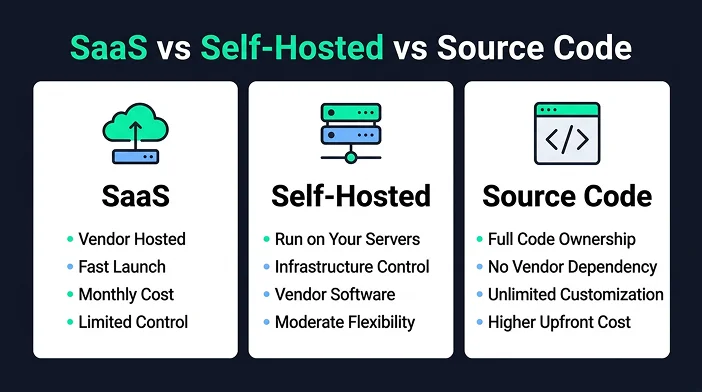
This is the most important choice you’ll make, and most vendor pages bury it.
SaaS white label means the vendor hosts the platform and you access it through a branded interface. You don’t own the underlying code. Monthly costs run $2,000 to $8,000 depending on feature tier and trading volume caps. This model makes sense if your priority is speed and you don’t need deep technical customization. The risk is dependency. If the vendor raises prices, changes their terms, or shuts down, you have no fallback.
Self-hosted white label gives you the software to run on your own servers. You control the infrastructure, the data, and the uptime. You still don’t have the source code in most cases, but you’re not relying on the vendor’s servers. This works well for operators who want operational control but aren’t planning major product changes.
Source code delivery is what you want if you’re building a long-term product. Full ownership of every contract, every backend service, every frontend component. No vendor dependency. You can audit everything, fork the codebase, license it, or rebuild specific components without starting from scratch. This model costs more upfront: typically $20,000 to $80,000 depending on feature scope. But your 12-month total cost of ownership is often lower because you’re paying nothing monthly after delivery.
One founder signed a SaaS contract at $4,000 per month, launched, grew to 8,000 active users over 11 months, and then got a price increase notice to $9,500 per month. They had no leverage and no exit path without rebuilding from zero. Budget a higher upfront cost for source code delivery. It’s cheaper than the alternative.
| Model | Cost | Launch Time | Source Code | Best For |
|---|---|---|---|---|
| SaaS | $2,000–$8,000/mo | 1–2 weeks | No | Early validation, low budget |
| Self-Hosted | $15,000–$40,000 upfront | 3–6 weeks | No | Operational control, no code changes |
| Source Code | $20,000–$80,000 upfront | 6–12 weeks | Yes | Long-term product, full independence |
What the Pricing Engine Actually Does
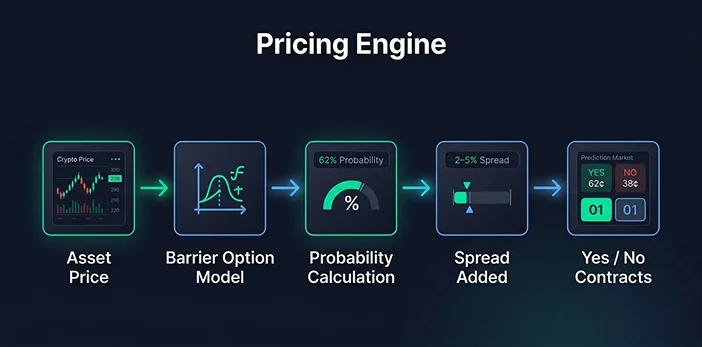
Most articles on white label prediction markets skip this entirely. The pricing engine is the core of the platform, and understanding it tells you which vendor is actually capable of building what you need.
Binary contracts price between 1 cent and 99 cents, representing the market’s estimated probability of an event resolving “Yes.” A contract priced at 62 cents means the market estimates a 62% chance the outcome occurs. If it resolves Yes, the contract pays $1.00. If it resolves No, it expires worthless. The operator earns the spread between the Yes and No contract prices, which is where configurable house edge comes in.
Price-based prediction markets (crypto price above X at expiry, S&P 500 up or down by 3pm) use barrier option pricing. This model takes the current asset price, the target price, the time remaining, and the implied volatility to calculate the probability of the outcome. Prices update every second as the underlying asset moves. This is the same math used in structured products and binary options, which is why the regulatory distinction between prediction markets and binary options matters in several jurisdictions.
Event-based markets (Who wins the 2026 elections? Will the Fed cut rates this quarter?) require an oracle to pull the real-world outcome and trigger settlement. Chainlink handles straightforward outcomes cleanly. Contested or subjective outcomes need a fallback dispute resolution layer. Platforms that don’t build this will have 11pm incidents where a developer has to manually patch a resolution.
A configurable spread of 2% to 5% on the combined Up/Down total is the standard operator margin. At $500,000 in daily trading volume, a 3% spread generates around $15,000 per day in gross operator revenue before infrastructure costs. That math is why this product makes sense for high-volume trading environments.
White Label vs Clone Script: A Practical Comparison
A white label prediction market platform is a licensed, production-ready system maintained by a development company. It typically includes ongoing support, regulatory compliance updates, feature releases, and in some cases a managed audit cycle. The vendor has skin in the game because their brand is attached to the platform’s performance.
A clone script is a one-time codebase purchase. You get the code, and from that point on you own the maintenance, the security updates, and any compliance changes. Clone scripts cost less upfront: typically $5,000 to $30,000. White label solutions cost more but include post-launch support that actually matters when something breaks at 2am.
The real comparison is this: if you have a technical team and can manage the codebase internally, a clone script with source code delivery is often the more cost-efficient path. If you don’t have that team and your priority is a working platform rather than a codebase to maintain, white label with ongoing support is the better fit. Don’t buy a clone script expecting white label levels of support. It doesn’t come with it.
Operator Revenue: What the Numbers Actually Look Like
Most white label vendors show revenue potential without showing the math. Here’s what it actually looks like at different volume levels.
At $100,000 in monthly trading volume, a 2% transaction fee generates $2,000 per month. That doesn’t cover a $4,000 SaaS subscription. This is why launching on a SaaS model before you’ve validated volume is a mistake. Your fixed costs exceed your revenue at low volume.
At $1 million in monthly volume, a 2% fee generates $20,000 per month. Now you’re operating profitably on most SaaS tiers and covering infrastructure on a self-hosted setup. This is the threshold where a white label platform starts making clear financial sense.
Beyond transaction fees, the operator revenue model includes market creation fees ($25 to $100 per externally submitted market), premium analytics subscriptions for power users, referral program commissions, and for crypto-native platforms, liquidity mining incentives that pull in trading volume by rewarding liquidity providers. One platform added a staking program after 90 days of operation. Within 45 days, their daily active traders increased 28% as liquidity depth improved and users had a reason to stay engaged beyond individual trades.
A configurable house edge set too high (above 8% combined) pushes sophisticated traders to competitors. Set it between 3% and 5% for most asset classes and you’ll retain the traders who matter while generating consistent margin.
Compliance, Geo-Blocking, and the Regulatory Reality
In the US, CFTC-regulated event contracts like those on Kalshi are legal for US users. Decentralized prediction markets like Polymarket are geo-blocked for US users following a CFTC enforcement action. If you’re building a decentralized platform and want to avoid regulatory exposure, geo-blocking US IP addresses is table stakes. It’s a configuration requirement that takes a day to implement and gets you out of a compliance conversation that could otherwise take years to resolve.
KYC and AML matter differently depending on your model. A fiat-accepting centralized platform serving US users needs full identity verification at account opening. Platforms like Sumsub handle this at $1 to $3 per verified user. A crypto-native platform using non-custodial wallets where users connect MetaMask and trade with their own USDC typically carries less KYC burden because you’re not holding or transmitting funds on their behalf. Get a legal opinion on this specific to your jurisdiction.
Sports prediction markets operate under state-specific rules in the US and under gambling licensing requirements in most European jurisdictions. If your target market is sports event trading, compliance should be your first conversation with any vendor, not your last.
The Hidden Cost: Liquidity and What Happens Without It
Every white label sales page mentions features. None of them mention liquidity bootstrapping, and that’s the item that will determine whether your first 90 days feel like a product or a demo.
An empty prediction market is a bad product. Users open it, see markets with no trading activity, and leave in under two minutes. It doesn’t matter how good the pricing engine is or how clean the UI looks. No liquidity means no price movement, which means no reason to trade.
For AMM-based platforms, you need seed capital in the liquidity pools from day one. Budget $5,000 to $20,000 to seed your first set of markets. For centralized binary contract platforms with a house edge model, liquidity isn’t a problem in the same way because the operator takes the other side of every trade. But you still need enough initial user volume to make the order book feel active.
The fastest path to visible liquidity at launch is a closed beta with 200 to 500 users who are specifically invited to trade. One team skipped the closed beta. Their public launch had 1,200 sign-ups in the first two days. Trading volume was nearly zero because every new user looked at the empty markets and assumed the platform wasn’t ready. They ran a 30-day relaunch campaign just to recover the impression.
Liquidity is a marketing problem disguised as a technical one. Budget for it before you budget for features.
Frequently Asked Questions
Q1: What’s the difference between a white label prediction market and a SaaS prediction market platform?
A white label platform gives you full brand control and, depending on the model, source code ownership or self-hosting capability. A SaaS prediction market is a subscription product where the vendor hosts everything and you access an operator interface. SaaS is faster to launch but creates vendor dependency. White label with source code delivery costs more upfront and gives you full independence. For early-stage founders, SaaS makes sense at low budgets. For anyone planning a long-term product, source code delivery is worth the extra investment.
Q2: How long does it take to launch a white label prediction market platform?
SaaS setups can go live in 1 to 2 weeks once branding and fee configurations are complete. Self-hosted white label deployments take 3 to 6 weeks including server provisioning, integration testing, and compliance setup. Source code delivery projects run 6 to 12 weeks depending on the scope of customization. The audit, if required, adds another 2 to 4 weeks on top of development.
Q3: Do I need a smart contract audit for a white label platform?
Centralized white label platforms that handle settlement through internal logic rather than on-chain contracts don’t require a smart contract audit. Decentralized platforms with Solidity contracts on Polygon or Base need an audit before going live with real user funds. Budget $10,000 to $25,000 for this. If you modify the vendor’s contracts for any reason, re-audit the changed scope.
Q4: Can a white label prediction market platform support sports markets?
Yes, but sports event markets require licensed real-time data feeds for settlement triggers, not just Chainlink price oracles. Look for vendors that support custom oracle configurations or have existing integrations with sports data providers like Sportradar or Stats Perform. Settlement latency matters: a market that resolves 20 minutes after a match ends creates arbitrage windows that sophisticated users will exploit.
Q5: What’s the realistic cost of a white label prediction market in 2026?
SaaS: $2,000 to $8,000 per month. Self-hosted white label: $15,000 to $40,000 upfront plus $300 to $800 per month in infrastructure. Source code delivery: $20,000 to $80,000 plus your own audit at $10,000 to $25,000. Add $5,000 to $20,000 for liquidity seeding and $3,000 to $10,000 for legal review. A realistic 12-month budget for a production-ready self-hosted or source code delivery platform runs $60,000 to $130,000 all in.
Q6: What’s the difference between binary options and prediction markets for compliance purposes?
Structurally, binary contracts on prediction markets and binary options are nearly identical: two outcomes, probability-based pricing, fixed payout. The regulatory distinction matters because binary options are banned or heavily restricted in the EU and UK after widespread retail fraud cases. Prediction markets have a more favorable regulatory profile when framed as event contracts rather than financial derivatives. This determines which licensing regime applies, what your marketing can say, and whether you can access certain payment processors. Get a jurisdiction-specific legal opinion before you go live.
Q7: Is it possible to launch a prediction market without coding experience?
With a SaaS white label, yes. Configuration, branding, and market creation all happen through operator dashboards that don’t require code. The limitations are on customization: you can’t modify the product logic, add novel features, or change how settlement works. For most early-stage founders testing a market, the no-code SaaS path is the right starting point.