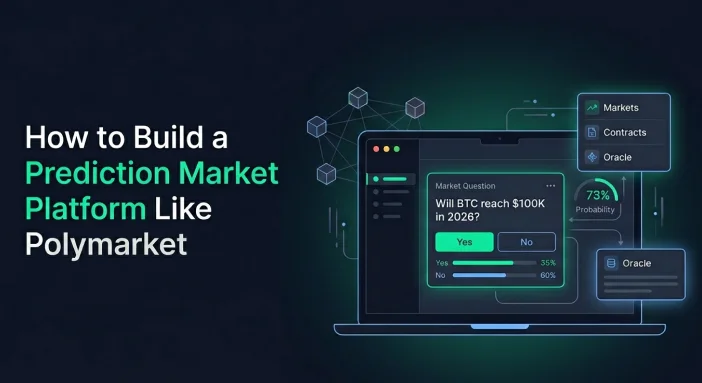
ICE made a strategic investment in Polymarket in 2025. That’s the same ICE that owns the New York Stock Exchange. When institutional infrastructure players start putting money into decentralized prediction markets, you pay attention. Polymarket hit $3.74 billion in a single month of 2025 volume, and Dune Analytics data shows it retains more than 85% of active users, which is exceptional by any crypto-native standard. So founders are asking the right question: how do you actually build something like this? The answer depends on which version of “like Polymarket” you mean, because there are three meaningfully different approaches and most guides conflate them.
Three Ways to Build a Prediction Market Like Polymarket
Integration-first: Build a product layer on Polymarket’s existing CLOB API. You get live markets, real liquidity, and real order books from day one. No smart contracts to write. No liquidity to bootstrap. Timeline: 4 to 10 weeks. Cost: $15,000 to $40,000. Right for: exchanges, wallets, and media platforms embedding prediction primitives into an existing product.
White-label or clone script: Deploy a pre-built Polymarket-style codebase with your branding, fee structure, and market categories. Timeline: 2 to 8 weeks. Cost: $10,000 to $50,000. Right for: founders who need to validate a niche before committing to a custom build.
Custom build: Write your own smart contracts, deploy your own CLOB or AMM, run your own oracle integrations. Timeline: 4 to 9 months. Cost: $30,000 to $150,000 plus audit. Right for: founders with a validated niche, a defined audience, and at least 6 months of runway.
What Polymarket Actually Built (Most Guides Get This Wrong)
Most guides describe Polymarket as “a decentralized prediction market on Polygon using USDC.” That’s accurate but incomplete, and the parts they skip are the parts that matter if you’re building something similar.
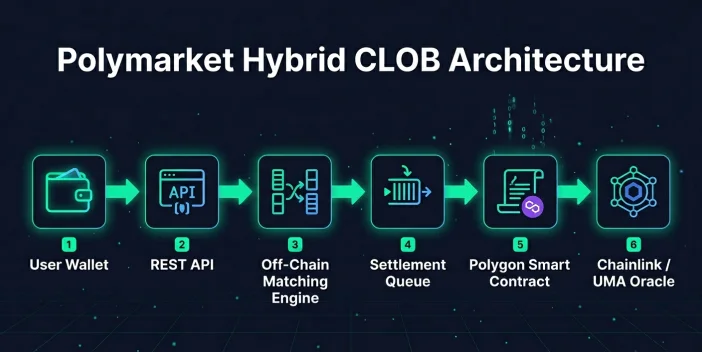
Polymarket runs a hybrid CLOB. The order book itself lives off-chain. Orders come in through a REST API, get matched in an off-chain engine, and only settlement hits the Polygon blockchain. This is not fully decentralized. It’s better described as non-custodial and transparent. User funds never leave their wallets. Settlement is on-chain. But order matching is centralized for performance, which is how Polymarket achieves WebSocket order book updates with latency under 50ms while keeping gas costs per trade under $0.01 on Polygon.
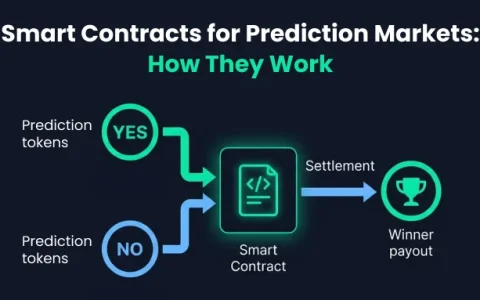
The smart contract layer uses the Gnosis Conditional Tokens Framework (CTF). One USDC mints one YES token plus one NO token. Combined value always equals $1.00. At settlement, winning tokens redeem at $1.00 and losing tokens expire worthless. UMA’s Optimistic Oracle handles disputed market resolutions. Chainlink handles price-based markets where deterministic data feeds apply.
The full stack: React frontend, Node.js backend, The Graph for market data indexing via GraphQL, PostgreSQL for off-chain order state, Redis for real-time price caching, Hardhat and Solidity for contract development.
One thing most guides miss entirely: Polymarket’s CLOB API is public and documented. Builders can access live order books, place orders programmatically, stream real-time market data, and interact with existing markets without deploying a single contract. This is the integration-first path, and it’s the fastest way to ship a prediction market product.
You can explore a ready-to-deploy Polymarket clone script to see what a production-grade script package looks like before committing to any build path.
The Integration-First Build: The Fastest Path Nobody Talks About
If your goal is speed and real trading depth from day one, build on Polymarket’s infrastructure rather than beside it. The CLOB API gives you live liquidity, real order books, and programmatic trading access without solving the bootstrapping problem yourself.
What you get for free: live pricing on thousands of active markets, an order book you didn’t have to seed, official client libraries for JavaScript and Python, and an existing user base creating arbitrage opportunities that attract algorithmic traders to your platform automatically.
What you still have to build: the product UX including onboarding, portfolio tracking, order entry, and market browse pages. The data layer including caching, aggregation of volume and trending markets, and performance optimization. Real-time infrastructure including WebSocket connections with proper reconnect logic and fallback handling. And the monetization layer, because Polymarket doesn’t share revenue with integrators.
This path is right for specific situations. If you’re an exchange, wallet, or media platform that wants prediction market exposure without running a separate product, embedding Polymarket primitives is faster than building your own market. It’s also where you learn the most about user behavior before committing capital to a custom build. The limitation is clear: you have no control over oracle resolution, market listing decisions, or fee structures. If your product vision requires those controls, integration-first is a stepping stone, not a destination.
Building Your Own: Tech Stack, Contracts, and What Takes the Longest
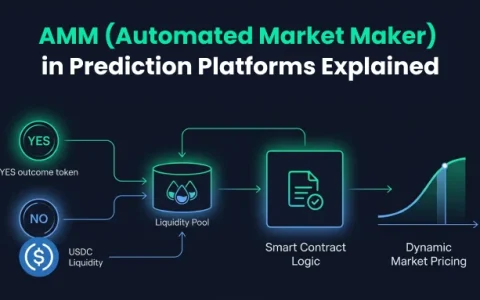
Smart contracts (4 to 8 weeks). Deploy a MarketFactory contract that creates individual Market contract instances on demand. Use the factory pattern so you can enumerate markets through The Graph without iterating on-chain arrays. Implement LMSR AMM for launch (bounds LP losses at b * ln(2), works at low volume). Add CLOB later when daily active traders exceed 1,000. Connect Chainlink Data Streams for price-based markets. Wire UMA’s Optimistic Oracle for event-based markets with subjective outcomes. Write and deploy using Hardhat on a Polygon testnet before mainnet.
Backend (3 to 5 weeks). Node.js API server (Fastify) handling order submission, cancellation, and user account management. Redis-backed in-memory order book for sub-millisecond matching. Settlement queue that batches matched trades and submits to Polygon in groups, reducing per-transaction overhead by 60% to 70%. PostgreSQL for off-chain order state. The Graph subgraph indexing MarketCreated, TradePlaced, and MarketResolved events for fast historical queries.
Frontend (3 to 5 weeks). React with Next.js. MetaMask and WalletConnect for Web3 wallet users. MoonPay integration for fiat-to-crypto onramp so users who don’t own USDC can still participate. WebSocket subscription for live order book updates at under 100ms. Mobile-first. The onboarding flow is where most teams underinvest and where most users drop off.
Audit (2 to 4 weeks, runs parallel). Budget $12,000 to $25,000. Scope includes the MarketFactory, all Market contract logic including finalize() and settlement functions, the AMM calculation library, and oracle integration wrappers. The most common vulnerabilities in prediction market contracts are reentrancy in settlement functions and integer overflow in LMSR calculations. Every prediction market contract needs at least two audit rounds before mainnet with real funds.
Total timeline for a production-ready custom build: 4 to 9 months. Total cost: $50,000 to $150,000 including audit, infrastructure setup, and Chainlink oracle costs for year one.
Why Prediction Market Platforms Fail
Most prediction market platforms that launch don’t survive their first year. The failure modes are consistent enough that you can design around them if you know what they are.
The liquidity bootstrapping problem kills most launches. An empty prediction market is a broken prediction market. Users arrive, see markets with no volume and stale prices, and leave in under two minutes. Budget $5,000 to $20,000 specifically for seeding your first AMM pools before public launch. Run a closed beta with 200 to 500 invited users before you announce publicly. Platforms that skip this step routinely report dead launches with strong sign-up numbers and near-zero trading activity.
Bad oracle configuration creates settlement disputes that destroy trust. One contested market that takes 11 days to resolve manually will do more damage to user trust than a month of good product work can repair. Configure UMA’s challenge period and dispute flow before you create your first market, not after. Document the resolution criteria explicitly in the market question before listing. Ambiguous questions are dispute invitations.
Platforms that don’t plan for retention don’t get it. Polymarket’s 85% retention figure is not an accident. Leaderboards, prediction streaks, and badge systems add lightweight gamification that gives casual users a reason to return daily even when they’re not actively trading. One platform added a weekly prediction streak feature and saw return visits from existing users increase 31% within 45 days.
Bot Volume, Liquidity, and the Market-Making Reality
Research citing Hubble Research data suggests bots and algorithmic strategies may account for around 37% of Polymarket’s trading volume. This is not a problem. It’s infrastructure. Bots are what keep order books alive between retail trading sessions. They’re the liquidity providers that ensure a user at 3am can still get a fill on a 65-cent YES position without moving the price by 8 cents.
The practical implication: your API design matters as much as your UI design. Algorithmic traders need low-latency WebSocket streams, batch order submission, efficient cancellation, and documented rate limits. If your API can’t handle this traffic, you won’t attract the market makers who keep your platform liquid. Without liquidity, your retail users experience slippage and stop trading.
If you build on Polymarket’s CLOB API, bot infrastructure is already in place. If you build your own platform, plan for API rate limiting, DDoS protection, and WebSocket connection pooling before you launch. The first wave of automated activity will test your infrastructure harder than any beta user group. Polymarket has introduced measures against latency arbitrage on short-term crypto markets specifically because the issue became significant enough at scale to require intervention. That’s a signal about what growth looks like, not a warning to avoid it.
Revenue, Retention, and What Keeps Users Coming Back
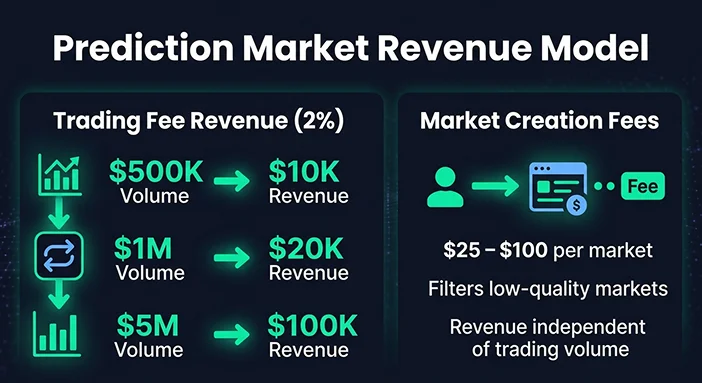
Transaction fees are the base. A 1% to 2% fee on settled trades is standard. At $1 million in monthly volume, 2% generates $20,000 in gross revenue. The unit economics are solid once you reach volume. Time-to-volume is the variable, and it depends almost entirely on liquidity depth.
Market creation fees add a second stream. Charge $25 to $100 per externally submitted market. This filters low-quality submissions, funds operational review of market criteria, and creates revenue that’s independent of trading volume.
The POLY governance token model (Polymarket’s approach in 2026) uses token distribution as both a liquidity incentive and a governance mechanism. For most founders, this is a version two or three feature. Don’t put DAO governance in version one unless governance is your product differentiation.
Gamification drives retention without requiring a token. Weekly prediction accuracy leaderboards, consecutive-day prediction streaks, and achievement badges for correct predictions cost almost nothing to build and measurably improve return visit rates. These features also generate social content that your most engaged users share, which is cheaper organic acquisition than any paid channel.
Build Path Decision Framework
| Situation | Recommended Path |
|---|---|
| Need live markets in under 60 days | Integration-first (Polymarket CLOB API) |
| Validating a niche with limited budget | White-label or clone script |
| Building on existing exchange or wallet | Integration-first |
| Sports, political, or custom market niche | Custom build or white-label |
| Have a technical co-founder and 6+ month runway | Custom build |
| Need full source code and IP ownership | Custom build with source code delivery |
| First prediction market product, no audience yet | White-label to validate, custom to scale |
Frequently Asked Questions
Q1: What’s the fastest way to launch a prediction market platform like Polymarket in 2026?
Building on Polymarket’s public CLOB API is the fastest path. You get live liquidity, documented order book access, and real markets without deploying contracts. A functional product layer takes 4 to 10 weeks and costs $15,000 to $40,000. For a fully independent platform, a white-label script deploys in 2 to 8 weeks at $10,000 to $50,000.
Q2: Does Polymarket make money, and how does it apply to a clone?
Polymarket earns transaction fees on settled trades, typically 1% to 2%. A similar platform with $500,000 in monthly volume at 2% earns $10,000 per month. Add market creation fees ($25 to $100 per market) and you have two revenue streams from day one. The challenge is reaching volume, not structuring the fee model.
Q3: What smart contracts do I need for a Polymarket-style prediction market?
At minimum: a MarketFactory that deploys individual Market contracts, an AMM contract using LMSR for liquidity, a settlement contract with finalize() logic and payout handling, and oracle integration wrappers for Chainlink and UMA. The Gnosis CTF can replace part of the custom AMM work, reducing audit cost by $5,000 to $10,000. Budget $12,000 to $25,000 for audit covering all contracts before mainnet deployment.
Q4: How do I handle the liquidity bootstrapping problem at launch?
Seed AMM pools with $5,000 to $20,000 before public launch. Run a closed beta with 200 to 500 invited users for two to four weeks. Start with three to five markets in a single category where you have audience access. Crypto price prediction markets have the lowest friction because Chainlink price feeds are deterministic and users already understand the context. Once those markets have visible volume, expand.
Q5: Why do so many prediction market platforms fail within a year?
Three consistent failure modes: empty order books that signal a dead product to new users, oracle disputes that take days to resolve and destroy trust, and no retention mechanics that give users a reason to return when they’re not actively trading. Platforms that launch without seeding liquidity, without documenting market resolution criteria, and without any gamification layer typically retain under 30% of their first-month users by month three.
Q6: Do I need CFTC compliance to launch a prediction market in 2026?
It depends on your users and architecture. Decentralized platforms like Polymarket geo-restrict US users to avoid CFTC jurisdiction. Centralized platforms accepting US users and real-money event contracts require CFTC registration (Kalshi’s model). A legal opinion specific to your architecture costs $2,000 to $4,000 and should happen before you write a line of production code. The cost of a retroactive compliance fix after launch is orders of magnitude higher.
Q7: How much does it cost to build a prediction market like Polymarket in 2026?
Integration-first: $15,000 to $40,000. White-label or clone script: $10,000 to $50,000 plus $12,000 to $25,000 for your own audit. Custom build: $50,000 to $150,000 all-in including audit, oracle costs, infrastructure, and legal review. A realistic 12-month total cost of ownership for a production-ready custom platform sits between $80,000 and $180,000 when you include post-launch operations, liquidity seeding, and the second audit cycle.