Most Polymarket clone script tech stack articles list React, Node.js, Solidity, and Chainlink and call it done. That’s not a tech stack. That’s a category list. The decisions that actually determine whether your platform ships, survives its first audit, and scales past 10,000 daily active users are buried underneath those category names. Which token standard do the outcome shares use and why? Which oracle do you wire for price-based markets versus political events? Do you use Hardhat or Foundry and what does that choice cost you in CI pipeline time? What does gasless meta-transaction support actually require at the contract level? This guide covers the layer below the category list.
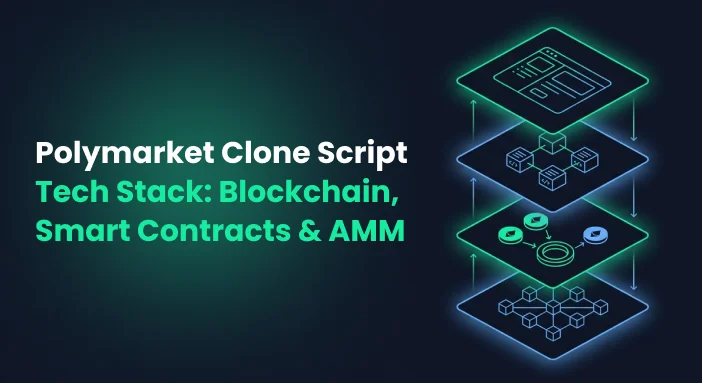
The Full Polymarket Clone Tech Stack
| Layer | Technology | Why |
|---|---|---|
| Smart Contracts | Solidity, OpenZeppelin, Gnosis CTF (ERC-1155) | Audited base, outcome token standard |
| Development Tooling | Hardhat (scripts) + Foundry (fuzz testing) | Complementary, not either/or |
| Oracle (price markets) | Chainlink Data Streams | Deterministic, pull-based, CRE automation |
| Oracle (event markets) | UMA Optimistic Oracle + DVM | Handles subjective outcomes |
| Trading Model | LMSR AMM at launch, CLOB at scale | Volume threshold matters |
| Blockchain | Polygon for MVP, Arbitrum/Base for scale | Gas cost vs ecosystem depth |
| RPC Node | Alchemy (primary) + QuickNode (failover) | Redundancy required |
| Backend | Node.js (Fastify), PostgreSQL, Redis | Order state + real-time cache |
| Indexing | The Graph subgraph + GraphQL | Off-chain query performance |
| Frontend | React, Next.js, Ethers.js | Standard Web3 frontend |
| Wallets | MetaMask, WalletConnect, Gnosis Safe (admin) | Non-custodial + multi-sig admin |
| Gasless | EIP-2771 + Biconomy Paymaster | UX for non-crypto users |
| Security | Slither + MythX (pre-audit), Certik/Halborn (audit) | Layers, not one pass |
| DevOps | Docker, Kubernetes, CI/CD with GitHub Actions | Container-based deployment |
Smart Contract Layer: CTF, ERC-1155, and the Market Factory
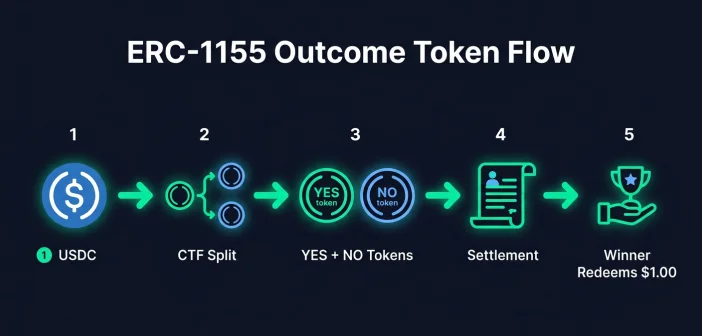
This is the layer that most guides describe as “Solidity smart contracts” and move on. The actual design decisions here determine your audit cost, your gas bill, and whether your contracts can be upgraded when something breaks.
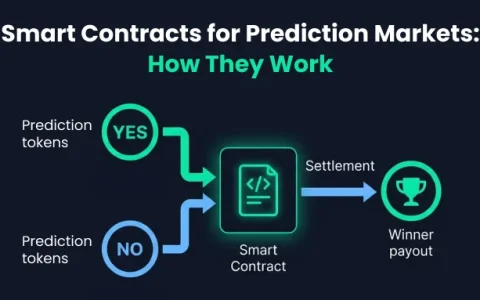
Conditional Tokens Framework (CTF) is the ERC-1155-based standard Polymarket uses for outcome shares. One USDC splits into one YES token plus one NO token. Combined value always equals $1.00. At settlement, winners redeem at $1.00 and losers expire at zero. Using CTF as your base layer means your outcome token logic is already audited by Gnosis. You write a wrapper that adds your fee logic, oracle integration, and market factory. This saves $5,000 to $10,000 in audit cost compared to writing custom token logic from scratch, because the CTF core doesn’t need to be in your audit scope.
The market factory pattern is non-negotiable for any platform expecting more than a handful of markets. You deploy one MarketFactory contract as a template registry. When someone creates a market, they call factory.createMarket(...), which deploys a fresh Market contract instance and emits a MarketCreated event. The Graph picks up that event and indexes the new market automatically. Without the factory pattern, a monolith contract managing all market state is both a gas nightmare and an audit red flag. One market’s bug can freeze all markets.
Gnosis Safe proxy handles admin wallets. The platform’s admin key should never be a single EOA (externally owned account). A 3-of-5 Gnosis Safe multisig means no single developer can trigger market resolution, withdraw fees, or upgrade contracts unilaterally. Every serious audit firm will flag a single-key admin wallet as a critical risk.
OpenZeppelin provides the base contract libraries: AccessControl for role-based permissions, ReentrancyGuard for settlement functions, Pausable for emergency stops. Don’t write these yourself. OpenZeppelin’s contracts are audited and save 40 to 60 hours of development time on security scaffolding alone.
For a full walkthrough of how these components fit together in a production deployment, see how to build a prediction market platform like Polymarket.
AMM vs CLOB: Choosing Your Liquidity Model and Why It’s Not Simple
LMSR (Logarithmic Market Scoring Rule) is the right AMM variant for binary prediction markets, not Uniswap’s constant product formula. Constant product AMMs (x * y = k) have unbounded LP loss when a market’s outcome becomes highly skewed. LMSR caps worst-case LP loss at b * ln(2), where b is the liquidity parameter set at market creation. With b at 10,000 USDC, your maximum LP exposure is about $6,931 regardless of how skewed the outcome becomes. That bounded loss is what makes seeding AMM pools viable for a startup operator.
LMSR has a gas cost tradeoff. The computation per trade is heavier than a constant product swap. On Polygon or Arbitrum, this is under $0.01 per trade. On Ethereum mainnet, it becomes real friction for small positions.
CLOB (Central Limit Order Book) gives better price discovery and tighter spreads, but it needs real volume. Below roughly 1,000 daily active traders, an empty order book signals a dead platform. Polymarket’s production CLOB processes order matching off-chain in a centralized engine and batches settlement on-chain, with WebSocket latency under 50ms. Start with LMSR AMM. Add CLOB after you’ve validated trading volume above 1,000 daily active users.
The negative-risk exchange adapter handles markets where combined YES and NO probabilities temporarily exceed 100%, which happens during high-volatility events when liquidity is added faster than prices equilibrate. Without it, your settlement arithmetic can break at peak trading moments. If you’re using CTF and running a production system with real user funds, you need this adapter or an equivalent safety mechanism in your settlement logic.
Oracle Layer: Chainlink vs UMA vs Pyth and When Each Applies
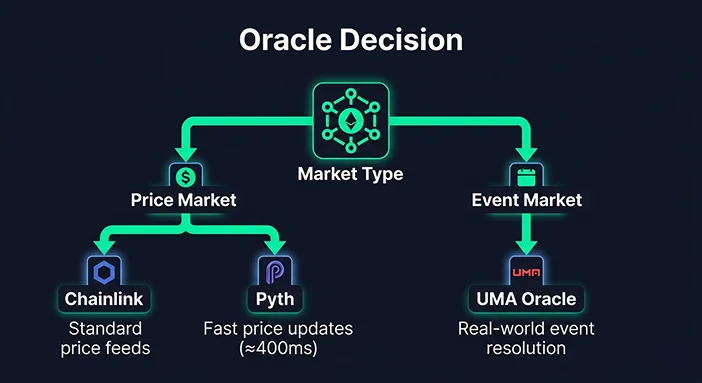
Chainlink Data Streams handles price-based markets correctly. Pull-based, sub-second updates eliminate the manipulation window around heartbeat updates. In 2026, Chainlink’s Runtime Environment (CRE) lets you automate the finalize() call when a price condition is met, removing the need for an admin to manually trigger settlement on every market. For a market like “Will BTC close above $100,000 on December 31?”, Chainlink handles this cleanly and requires no additional dispute layer.
Pyth Network is the right choice for short-duration markets (under 4 hours). Pyth publishes prices every 400 milliseconds versus Chainlink’s slower heartbeat cadence. For same-day or sub-4-hour markets, a 10-minute Chainlink update lag creates an arbitrage window that sophisticated traders exploit. Pyth’s 400ms cadence closes that window.
UMA’s Optimistic Oracle handles everything no price feed covers: election outcomes, sports results, corporate announcements, custom questions. Anyone proposes an outcome after a market closes. If no one disputes within the challenge window (12 to 24 hours), the market resolves. Disputes route to UMA’s Data Verification Mechanism (DVM) where UMA token holders vote. Use UMA for any market where the outcome is a real-world event rather than a continuously published data series.
Never let any market auto-resolve from a single oracle feed without a finalize() call that can be triggered by any participant. Requiring an explicit on-chain finalization action means the resolution can be disputed before it executes. Auto-resolve from a single feed is a manipulation target.
| Oracle | Update Speed | Best Market Type | Notes |
|---|---|---|---|
| Chainlink Data Streams | Sub-second (pull) | Crypto, forex, commodities | Full Polygon support, CRE automation in 2026 |
| Pyth Network | 400ms | Short-duration (<4 hr) price markets | Closes latency arbitrage window |
| UMA Optimistic Oracle | 12–24 hr challenge window | Events, politics, sports, custom | DVM token holder voting for disputes |
Chain Selection: Polygon vs Arbitrum vs Base
Polygon PoS is the obvious MVP chain. EVM-compatible, Chainlink fully supported, gas under $0.01 per transaction, deep developer ecosystem, and Polymarket’s production network. The risk: Polymarket itself is signaling migration away from Polygon as volume scales. Polygon works for your first 12 to 18 months, but your architecture should assume eventual migration.
Arbitrum offers deeper DeFi ecosystem integration if your prediction market overlaps with DeFi use cases. Arbitrum’s TVL and developer activity are higher than Polygon in 2026. Gas costs are comparable. Chainlink and UMA both have full support. Audit firms who know Arbitrum-specific quirks (sequencer assumptions, L1 fallback behavior) are more available than they were 24 months ago.
Base is the right choice if your target audience includes users already in Coinbase’s ecosystem. Base’s fiat onramp via Coinbase is smoother than any third-party solution, which matters if your users aren’t crypto-native. The ecosystem is younger than Polygon or Arbitrum, so some tooling is less mature.
Don’t deploy on Ethereum mainnet for a consumer prediction market. A user placing a $10 bet shouldn’t pay $3 in gas. Mainnet is right for institutional-scale markets where transaction sizes are large enough to absorb L1 gas costs.
Backend Stack: Node.js, PostgreSQL, Redis, and The Graph
Node.js with Fastify handles the API layer: order submission, cancellation, user account management, and webhook delivery for settlement events. Fastify’s performance advantage over Express matters when your API processes thousands of order submissions per minute during a high-volume event. One prediction market launched on Express, hit a political event where volume spiked 40x in 20 minutes, and lost 14% of orders to timeout errors. They rebuilt on Fastify. The re-architecture took three weeks.
PostgreSQL stores off-chain order state, user positions, market metadata, and fee accounting. Don’t use it for real-time price serving. Its strength is relational queries with consistency guarantees. Use it for anything where data needs to be accurate and auditable: who placed which orders, what fees were collected, which positions are open.
Redis serves real-time price data between blockchain confirmations. On-chain state takes 2 to 12 seconds to confirm on Polygon. Your off-chain matching engine pushes price updates to Redis on every trade. The WebSocket server reads from Redis and pushes to connected frontends. When a settlement confirms, The Graph updates and the frontend reconciles against the on-chain truth.
The Graph subgraph indexes your contract events into a queryable GraphQL API. MarketCreated, TradePlaced, and MarketResolved events all index automatically. Your frontend can then ask “give me all markets resolving in the next 24 hours with more than 500 USDC in liquidity” in under 100ms. Without a subgraph, that query would require iterating on-chain storage, which is slow and expensive at scale.
RPC nodes: Alchemy as your primary endpoint, QuickNode as your failover. Never run a production system on a single RPC provider. Alchemy went down during a high-volume event in 2024 and platforms without failover went with it. The cost of a second RPC provider is under $500 per month.
Gasless Transactions: EIP-2771, Biconomy, and Why Founders Skip This Wrongly
New users who aren’t crypto-native don’t own MATIC or ETH to pay gas. They connect their wallet, try to place their first trade, hit an “insufficient funds for gas” error, and leave. You’ve acquired that user through marketing spend and lost them on a technical friction point that’s fully solvable.
EIP-2771 is the Ethereum standard for meta-transactions. The user signs their transaction intent with their private key. A trusted relayer submits the actual blockchain transaction and pays the gas. The relayer recovers gas cost from the platform’s paymaster contract. The user experience is: click, confirm signature, done. No gas required.
Biconomy is the most widely deployed paymaster infrastructure for this pattern. Their SDK integrates with Ethers.js in about two days of development work. You deposit USDC or MATIC into their paymaster contract, and Biconomy handles the relaying. Cost is typically $0.01 to $0.05 per subsidized transaction. Subsidize gas for first-time users during onboarding. The cost of subsidizing 1,000 first trades at $0.03 each is $30. Platforms that implement gasless onboarding consistently see first-session conversion rates 25% to 40% higher than those that don’t.
Security Stack: Hardhat vs Foundry, Audit Scope, and Bug Bounties
Hardhat vs Foundry: use both. Hardhat integrates better with JavaScript/TypeScript deployment scripts and CI pipelines that mix Solidity and Node.js tooling. Foundry is better for fuzz testing and Solidity unit tests. Foundry’s forge fuzz tests your LMSR calculation library with thousands of randomized inputs automatically, finding edge cases that manual test cases miss. LMSR integer overflow is a documented vulnerability class in prediction market contracts. Foundry fuzz testing is the cheapest way to find it before your auditor does.
Pre-audit automated scanners: run Slither and MythX before you engage an audit firm. Slither is a static analysis tool that catches common Solidity vulnerabilities in minutes. MythX provides deeper symbolic execution analysis. Neither replaces a manual audit, but using them first means auditors spend their time on complex logic vulnerabilities rather than issues a scanner catches for free. Paying a Certik or Halborn auditor to identify a missing ReentrancyGuard is expensive. Slither catches it in under a minute.
Audit scope for a Polymarket clone: the MarketFactory, all Market contract logic including finalize() and settlement functions, the LMSR calculation library, oracle integration wrappers, the CTF wrapper, and the Gnosis Safe integration. Budget $15,000 to $25,000 from a firm like Certik, Halborn, or Trail of Bits. Plan for two rounds: one pre-launch and one after your first significant contract modification.
Bug bounty programs should launch alongside your mainnet deployment. Immunefi is the standard platform for Web3 bug bounties. Set critical vulnerability payouts at $10,000 to $50,000 depending on severity. This costs nothing unless a vulnerability is found, and it creates ongoing security review by the global Web3 security community.
Frequently Asked Questions
Q1: What token standard do outcome shares use in a Polymarket clone?
ERC-1155, via the Gnosis Conditional Tokens Framework (CTF). ERC-1155 handles multiple token types (YES and NO for each market) within a single contract, which is more gas-efficient than deploying separate ERC-20 tokens per market. The CTF is audited by Gnosis and reduces the custom contract surface area you need audited, saving $5,000 to $10,000 in audit cost.
Q2: What’s the difference between Hardhat and Foundry and which should I use?
Hardhat integrates better with JavaScript/TypeScript deployment scripts and is the right choice for CI pipelines mixing Solidity and Node.js tooling. Foundry is better for fuzz testing and Solidity unit tests. Use both: Foundry for contract testing (especially LMSR fuzz coverage), Hardhat for deployment scripts and integration tests against forked mainnet state. Choosing one exclusively leaves gaps in either developer workflow or test coverage.
Q3: What does a Polymarket clone smart contract audit actually need to cover?
The MarketFactory, all Market contract logic including finalize() and payout functions, the LMSR or AMM calculation library, oracle integration wrappers, the CTF wrapper, and the Gnosis Safe admin integration. Run Slither and MythX before engaging auditors to clear the low-hanging issues. Budget $15,000 to $25,000 for a named firm and plan for a second audit pass after any significant contract modification post-launch.
Q4: Why use EIP-2771 gasless transactions and when should I implement them?
New users who aren’t crypto-native don’t own gas tokens. They hit an “insufficient funds for gas” error on their first trade and leave. EIP-2771 meta-transactions let a relayer submit and pay for the transaction on the user’s behalf. Biconomy implements this in about two days of integration work at $0.01 to $0.05 per subsidized transaction. Platforms that implement gasless onboarding see first-session conversion rates 25% to 40% higher than those that don’t.
Q5: Should I deploy on Polygon, Arbitrum, or Base in 2026?
Polygon for an MVP launching in the next 90 days: full Chainlink support, deep developer ecosystem, lowest friction. Arbitrum if your prediction market overlaps with DeFi use cases or you plan to integrate with DeFi protocols. Base if your target users are Coinbase-adjacent and you want their native fiat onramp. Don’t deploy on Ethereum mainnet for consumer prediction markets — gas makes small-stake trades economically unviable.
Q6: What does the negative-risk exchange adapter do and do I need it?
It handles markets where combined YES and NO probabilities temporarily exceed 100%, which happens during high-volatility events when liquidity is added faster than prices equilibrate. Without it, your settlement arithmetic can break at peak trading moments. If you’re using Gnosis CTF and running a production system with real user funds, yes, you need this or an equivalent safety mechanism in your settlement logic.
Q7: How much does the full tech stack cost to deploy for a Polymarket clone in 2026?
Smart contract development: $20,000 to $50,000. Audit (two rounds): $15,000 to $25,000. Backend development (Node.js, PostgreSQL, Redis, The Graph): $15,000 to $30,000. Frontend (React, Ethers.js, wallet integration): $10,000 to $20,000. Infrastructure (Alchemy, QuickNode, Docker, Kubernetes): $500 to $1,500 per month. Chainlink oracle costs: $500 to $2,000 per month. Biconomy gasless subsidy: $30 to $300 per month. Realistic 12-month total: $80,000 to $150,000 all in.