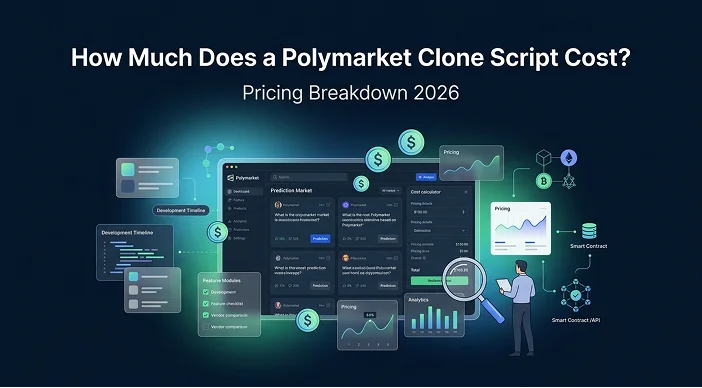
Polymarket crossed $1 billion in trading volume in a single month by late 2025. Kalshi hit $50 billion in annualized volume, up from $300 million the year before. Founders noticed. So how much does a Polymarket clone script cost? That’s the question every startup founder in this space eventually types into Google — and rarely gets a straight answer to.
Most vendor pages quote “$10,000 to $50,000” and stop there. That range tells you almost nothing. A stripped-down MVP and a full white-label platform with Chainlink oracle integration and multi-chain support are completely different products. Your actual number depends on five or six specific decisions you’re about to make. Get those wrong and you can double your budget before you ship a single market.
What a Polymarket Clone Script Actually Includes
Before you price anything, you need to know what you’re buying. A clone script isn’t one thing. It’s a stack of components, each carrying its own cost weight, and knowing which ones you actually need saves you from paying for scope you won’t use at launch.
The foundation is the smart contract layer: market factory, AMM or CLOB logic, settlement contracts, and the fee distribution module. This is where most of the engineering risk sits. On Polygon, deploying and testing these contracts takes 2 to 4 weeks and accounts for 30% to 40% of a base package cost. It’s the part you don’t cut corners on. One client tried to speed this up by skipping testnet validation. The settlement contract had a rounding bug that miscalculated payouts on binary markets. The fix cost more than doing it right the first time.
The oracle integration is the second critical layer. Platforms like Polymarket use decentralized oracles (Chainlink or UMA) to pull verified real-world event outcomes on-chain. Without this, market settlement is manual. Chainlink integration adds $3,000 to $8,000 to development cost depending on the number of data feeds you need — and that’s separate from the ongoing monthly subscription fees.
The rest of the stack covers the trading interface (React or Next.js), wallet connectivity (MetaMask, WalletConnect), admin dashboard, USDC stablecoin integration, user authentication, and the backend API layer (Node.js or Laravel). Each part is buildable. Together they form the full product. Understanding what’s in a package versus what’s an add-on is the fastest way to avoid a quote that looks affordable until month two of development.
How Much Does a Polymarket Clone Script Cost? The Three Tiers Explained
Most providers structure Polymarket clone offerings across three tiers. Here’s what they actually mean in scope, time, and money — not the version you read in a sales brochure.
Tier 1: MVP Launch Package — $10,000 to $25,000 / 4 to 6 Weeks
This is the right entry point if you want to test market fit before committing serious capital. You get a working prediction market on Polygon, core AMM smart contracts, a basic trading UI, wallet connectivity, USDC support, and a simple admin panel. Oracle integration at this tier is typically manual. You resolve markets through the admin dashboard rather than automated on-chain feeds.
This isn’t a product you take to Series A investors. It’s a prototype with real trading functionality.
One client launched their MVP for $18,000, ran it across three election markets during a regional vote cycle, and used the volume data to close a $400,000 seed round six weeks after launch. The MVP paid for itself before the check cleared. That’s the use case for this tier — validate fast, spend smart, raise on proof.
Tier 2: Full White-Label Platform — $25,000 to $60,000 / 8 to 12 Weeks
This is where most serious founders land. Full white-label means your branding, your domain, custom market categories, and a Chainlink oracle integration for automated settlement. You also get a polished trading interface, multi-wallet support, a feature-complete admin dashboard with market management tools, and optionally a second blockchain like BNB Chain or Arbitrum alongside Polygon.
At $40,000 — roughly the midpoint of this tier — you’re buying a production-ready platform. Not every feature Polymarket has (Polymarket employs an entire engineering team), but everything you need to launch publicly, generate trading fees, and attract your first 500 active users. Most founders who’ve done this before start here.
Tier 3: Enterprise Build — $60,000 to $150,000+ / 16 to 24 Weeks
This tier covers platforms with regulatory requirements, full multi-chain deployment, custom tokenomics, advanced liquidity pool architecture, KYC/AML compliance API integrations, mobile apps, and SLA-backed post-launch support. If you’re targeting the US or EU where compliance is non-negotiable, most of the added cost is legal and regulatory engineering, not frontend polish. Expect the compliance layer alone to account for $15,000 to $30,000 of this tier’s range.
| Package | Cost Range | Timeline | Best For |
|---|---|---|---|
| MVP Launch | $10,000 to $25,000 | 4 to 6 weeks | Validate market fit before committing budget |
| White-Label | $25,000 to $60,000 | 8 to 12 weeks | Full production launch with branding and oracles |
| Enterprise | $60,000 to $150,000+ | 16 to 24 weeks | Regulated markets, multi-chain, custom tokenomics |
What Custom Development Really Costs
If you’re thinking about building from scratch: north of $150,000, and that’s if everything goes right.
More realistically, a complete custom-built prediction market platform with smart contracts, oracle integration, liquidity pools, admin tools, and a polished frontend runs $200,000 to $500,000 in development. Timeline is 12 to 18 months. We’ve watched teams underestimate this badly. One founder came to us after spending $180,000 over 8 months with a freelance team. They had a partially working trading engine but no oracle integration, no admin dashboard, and a frontend that needed a full redesign. They switched to a white-label foundation and shipped in 10 weeks.
Custom development makes sense when your requirements genuinely can’t be met by an existing codebase — unusual market mechanics, proprietary AMM formulas, or jurisdictions requiring deeply custom compliance architecture. For most founders at the pre-revenue stage, it’s the slowest and most expensive path to the same outcome. The only thing custom-from-scratch reliably delivers faster is the point where you run out of budget.
Hidden Costs That Catch Founders Off-Guard

The development quote isn’t your total cost. These are the line items that show up after launch, and they add up faster than most first-time founders expect.
Smart Contract Security Audit: $8,000 to $25,000. This is non-negotiable before real user funds enter the platform. Certik, Hacken, and Code4rena are the firms most production platforms use. Don’t skip this to save budget. One smart contract exploit, and you’re done — not just financially, but reputationally. Most reputable providers deliver audit-ready code. Verify that before signing anything.
Chainlink Oracle Subscriptions: $200 to $1,000 per month, depending on the number of active data feeds. This is a fixed operating expense from day one. It’s not optional if you want automated settlement.
Polygon Gas Costs: At moderate traffic (1,000 to 5,000 transactions daily), budget $500 to $2,000 per month. Far lower than Ethereum mainnet, but not free. This number scales with user activity, so model it against your projected volume.
Post-Launch Maintenance: Around $2,000 to $5,000 per year for smart contract upkeep, dependency updates, and minor UI fixes. Any significant feature update may require a partial re-audit, which brings the audit cost back into play. Plan for it.
IPFS and CDN Hosting: Decentralized platforms often use IPFS for certain assets. Factor in $100 to $300 per month for storage and CDN delivery at early-stage traffic levels. Small line item, but founders consistently forget it in their launch budget.
What Pushes Your Price Up or Down
A few decisions have more impact on your final development quote than anything else. Know these before your first vendor call.
Blockchain choice. Polygon is the default for good reason. Low gas fees, EVM-compatible, solid developer tooling, and the same network Polymarket itself runs on. Choosing Ethereum mainnet triples gas costs and slows deployment. Adding BNB Chain or Arbitrum alongside Polygon adds $5,000 to $12,000 depending on the contract scope. Non-EVM chains like Solana require a separate smart contract rewrite and shouldn’t be on a first-version roadmap.
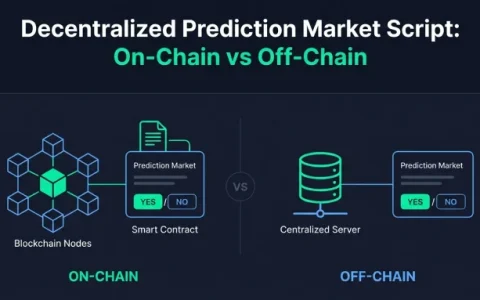
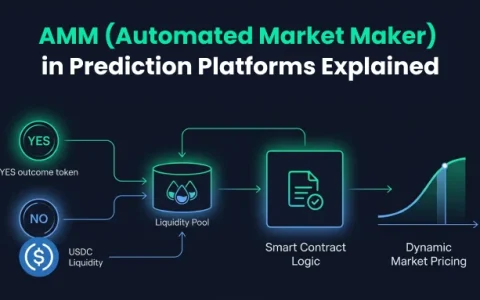
AMM vs. CLOB architecture. AMM (Automated Market Maker) sets prices via formula. Simpler to build, sufficient for most early-stage platforms. CLOB (Central Limit Order Book) matches buy and sell orders directly, enabling tighter spreads for high-volume traders. The real Polymarket uses a CLOB on Polygon. But CLOB requires significantly more smart contract engineering and a separate order-matching engine. This choice alone adds $8,000 to $20,000 to your quote. Unless you’re targeting professional traders from launch, start with AMM.
Market category depth. Covering politics, sports, crypto, finance, and entertainment with separate oracle feeds and resolution logic per category adds scope fast. Start with one or two categories your target audience actually cares about. Expand with revenue. For a full breakdown of how market categories tie into your revenue model, the prediction market business model guide covers exactly how fee structures differ by market type.
Regulatory compliance layer. If you need KYC/AML for US or EU users, add $15,000 to $30,000 for compliance API integration, geo-blocking logic, and the documentation your legal team will ask for. This isn’t optional overhead. It determines whether your banking relationships survive your first year of operation.
A Quick ROI Case for Founders
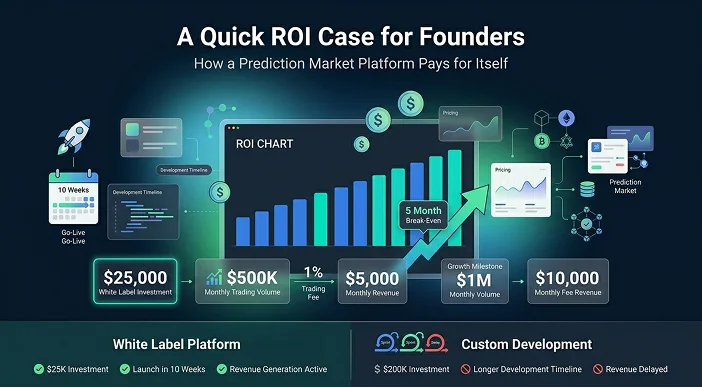
At a 1% average trading fee on $500,000 in monthly volume, you’re collecting $5,000 per month. That covers break-even on a $25,000 white-label package in five months. At $1 million in monthly volume — not an unrealistic target for a niche prediction market with an active user base — you’re looking at $10,000 per month in fee revenue before any secondary monetization like premium listings or data subscriptions.
And this is the argument that actually closes the case for a clone script over custom development. Every month of custom builds that delays your go-live is a month of fee revenue you’re not collecting. A $25,000 white-label platform live in 10 weeks earns while a $200,000 custom build is still in sprint three. The development cost difference is real. The opportunity cost difference is larger.
To see exactly which revenue streams stack on top of trading fees — spread capture, data APIs, liquidity incentives, and token models — see how prediction market platforms generate revenue in 2026.
Frequently Asked Questions
What is the cheapest way to launch a prediction market platform in 2026?
An MVP clone package is the lowest-cost route, typically $10,000 to $15,000 for a Polygon-based platform with AMM smart contracts, a basic trading UI, USDC support, and manual oracle resolution. It won’t have automated settlement or full custom branding, but it’s functional enough to test with real users and generate initial trading volume before you invest in a full build.
How long does a Polymarket clone script take to deploy?
MVP packages take 4 to 6 weeks from kickoff to live deployment. White-label builds with Chainlink integration and custom branding take 8 to 12 weeks. Enterprise builds run 16 to 24 weeks, especially when a compliance layer is involved. One thing that consistently extends timelines is unclear requirements at the start. Define your blockchain, your market categories, and your oracle setup before kickoff and you’ll cut 2 to 3 weeks off any tier.
Do I need a smart contract audit before going live?
Yes. No exceptions. User funds flow through these contracts. An audit from a credible firm — Certik, Hacken, or Code4rena — costs $8,000 to $25,000 and takes 1 to 3 weeks depending on contract complexity. Skipping it to save budget is the most common mistake first-time prediction market founders make. One exploit before you’ve built trust with your user base and the platform doesn’t recover. Most reputable clone providers deliver audit-ready codebases. Confirm this before you sign.
Can a Polymarket clone script support multiple blockchains?
Yes, but it adds cost and complexity. Starting on Polygon and expanding to Arbitrum or BNB Chain later is a much cleaner path than launching multi-chain on day one. Adding a second EVM-compatible chain typically costs $5,000 to $12,000 and extends the timeline by 2 to 4 weeks. Non-EVM chains like Solana require a separate smart contract rewrite and are better treated as a v2 roadmap item.
What oracle does Polymarket use, and is Chainlink included in clone scripts?
The original Polymarket uses UMA’s optimistic oracle for market settlement. Most clone scripts ship with Chainlink as the default since it supports a broader range of event data types and is more straightforward to configure out of the box. Chainlink integration is typically included in white-label and enterprise tiers. For MVP packages, it’s usually available as an add-on at $3,000 to $5,000. Either way, confirm oracle architecture with your provider before contracts are signed.
What’s the real difference between AMM and CLOB in a prediction market context?
AMM (Automated Market Maker) prices outcomes using a formula tied to liquidity ratios. It’s simpler to build, requires less infrastructure, and works well for early-stage platforms with moderate volume. CLOB (Central Limit Order Book) matches buy and sell orders directly, like a traditional exchange, and produces tighter spreads for high-frequency traders. Polymarket runs a CLOB on Polygon. For most founders launching their first platform, AMM is the right starting architecture. Migrating to CLOB once you have consistent volume is a realistic v2 upgrade, not a day-one requirement.
Is a prediction market platform profitable at early stage with low volume?
It depends on your cost structure. If you launch an MVP at $15,000 with no recurring oracle subscription and minimal hosting, you could break even at around $50,000 to $80,000 in monthly trading volume at a 2% fee rate. With a full white-label build and proper audit costs factored in, the realistic monthly break-even volume is closer to $300,000 to $500,000. Most platforms don’t hit that in month one. That’s exactly why starting with an MVP and scaling infrastructure with revenue makes more financial sense than over-building before you’ve validated a single market category.